

Messaging apps have become the digital highways of modern life. We use them to share personal moments, manage work, organize communities, and even handle payments. Yet the more messaging becomes central to society, the more its weaknesses stand out. Traditional platforms are often built on centralized infrastructure, where user data can be collected, analyzed, and monetized. Privacy depends on corporate policies that can change at any time. Account access can be restricted, conversations can be moderated or blocked. users typically have little control over how identity and data are stored.
This is where blockchain-based communication is gaining attention. A blockchain messenger is not just a trendy label; it’s a meaningful response to the growing demand for privacy, transparency, and digital ownership. In a blockchain messenger environment, users can have stronger control over identity, messages can be secured with cryptography. The network can be designed to reduce reliance on centralized servers. Instead of trusting a single company, users trust a verifiable system where rules and transactions can be audited.
How the TomaTok and Aylab Partnership Expands Blockchain Messaging Reach
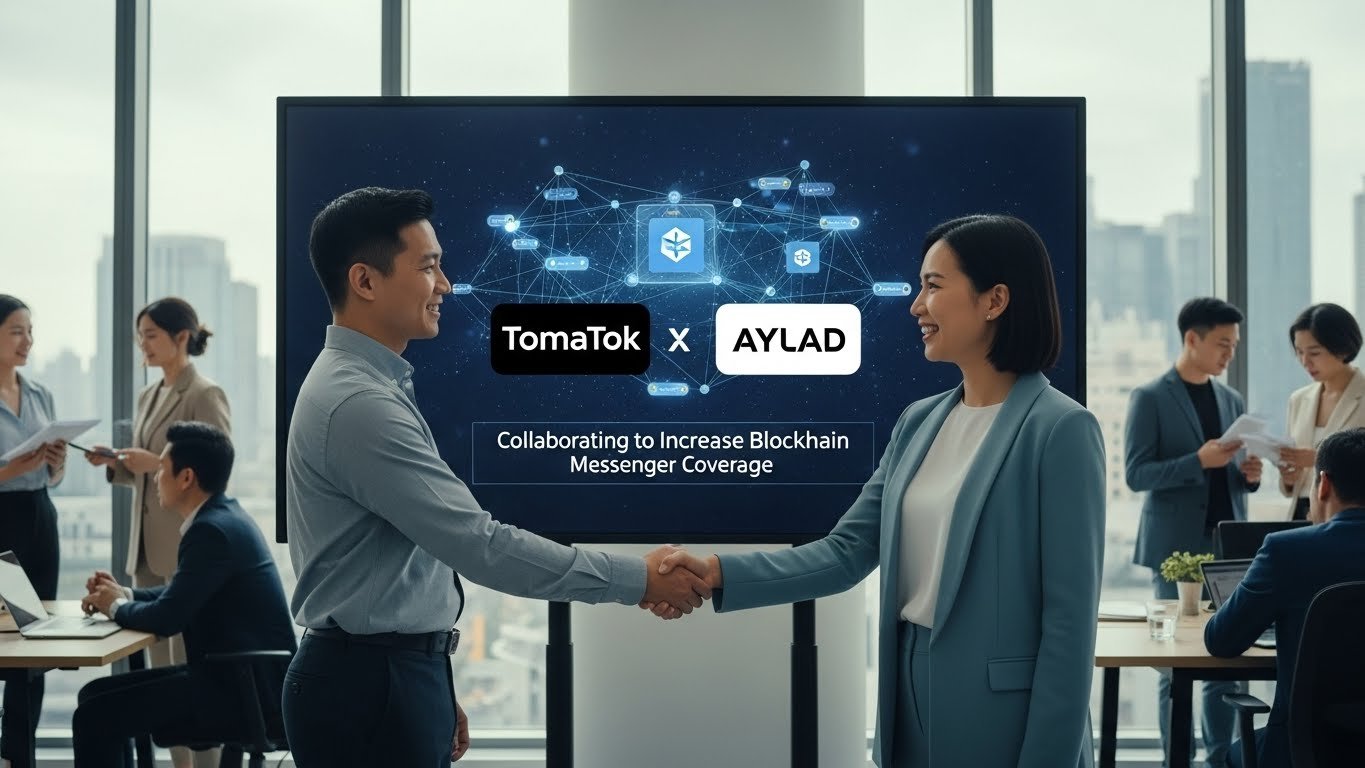
Within this expanding space, the collaboration between TomaTok and Aylab is drawing interest for one main reason: coverage. A blockchain messenger can have great features, but without scale and reach, it remains a niche product. Coverage means the ability to support more users, more regions, more devices, and more communication scenarios while maintaining reliability and security. The partnership between TomaTok and Aylab aims to push blockchain messenger adoption beyond early adopters and into wider everyday use.
Why coverage is the key battleground for blockchain messenger platforms, and how TomaTok and Aylab can increase adoption through technology, ecosystem partnerships, and user-centered design. We’ll also break down the broader implications for Web3 communication and what users and businesses can expect as blockchain messaging moves into its next phase.
Why Blockchain Messenger Coverage Matters More Than Hype
A lot of blockchain projects focus on launching features and collecting attention. Messaging, however, is a different category. People choose messaging apps based on whether their friends, family, colleagues, or communities are already there. This makes messaging a classic network-effect product, where the best technology can still lose if it lacks adoption. Blockchain messenger coverage becomes the bridge between a technically strong idea and a platform that people actually rely on daily.
Coverage isn’t only about geographic reach. It includes infrastructure performance, reliability across devices, language support, accessibility, user onboarding, and the ability to support different market needs. If a blockchain messenger only works smoothly for a small subset of users. It won’t compete with mainstream apps that have spent years optimizing every tap, swipe, and notification.
Coverage Over Hype: TomaTok and Aylab’s Strategy for Blockchain Messaging
TomaTok and Aylab collaborating to increase the coverage of blockchain messenger suggests a strategic focus on scale rather than just experimentation. Instead of only building for crypto insiders, the partnership aims to strengthen the foundation needed for mass adoption. That means making the platform faster, easier, and more trustworthy, while ensuring that its blockchain core doesn’t slow down the user experience.
This is also why coverage matters more than hype. Hype can bring downloads, but it doesn’t create retention. Messaging apps succeed when people come back multiple times per day. Trust the platform with real conversations, and invite others to join. By prioritizing coverage, TomaTok and Aylab are placing their bet on long-term adoption rather than short-lived excitement.
Understanding the Roles: What TomaTok and Aylab Bring to the Table
TomaTok’s Messenger Vision and Community Momentum
TomaTok’s identity in the market is tied to the idea of making blockchain messaging practical. While many Web3 communication products lean heavily into technical complexity. TomaTok’s messaging approach is often framed around usability and community-driven growth. This matters because blockchain messaging needs to appeal to real users who care about convenience and trust, not just cryptographic purity.
In the context of collaboration, TomaTok’s strength likely lies in product direction, user engagement strategies, and building a recognizable ecosystem around a blockchain messenger. A messenger is not only software; it’s a living network with communities and creators. A platform must make people feel safe and empowered while giving them reasons to interact, such as group tools, community channels, token-based engagement, or creator-friendly features.
Aylab’s Infrastructure and Scaling Capabilities
For a blockchain messenger, infrastructure is where promises become reality. Speed, stability, and scalability define whether the messenger works in real conditions. Aylab’s role in this collaboration is best understood as a technical reinforcement layer. Focusing on expanding performance and ensuring that the blockchain messenger can scale.
Aylab’s Role in Building Scalable Blockchain Messenger Infrastructure
Aylab’s contribution can include areas like distributed architecture, optimized node connectivity. Improved synchronization, identity modules, and tools that help the network run smoothly in different regions. When coverage expands, infrastructure requirements multiply. A system that handles thousands of users can fail when it needs to handle millions unless it is engineered for scale.
Together, TomaTok and Aylab can complement each other by combining product vision and community-building with stronger backend foundations. In the blockchain messenger space, that combination is exactly what’s needed to compete with mainstream platforms. While still delivering the values of decentralization and privacy.
The Core Goal of the Collaboration: Increasing Coverage of Blockchain Messenger

Coverage as a Multi-Layer Challenge
When TomaTok and Aylab collaborate to increase the coverage of blockchain messenger, they’re addressing a challenge that exists on multiple layers at once. Coverage is not one problem; it’s a stack of interconnected problems that must be solved together.
At the network layer, coverage means reliable operation across regions, with optimized routing and consistent uptime. the product layer, it means supporting different devices, operating systems, and connectivity environments. And at the trust layer, it means ensuring that privacy and security remain strong even as usage expands.
This is why blockchain messenger coverage is such a powerful focus point. If the partnership succeeds. It can create a messenger that feels as seamless as mainstream apps, while still offering the benefits of decentralized communication, encrypted messaging, and user-owned identity.
Expanding Coverage Without Sacrificing Security
A major risk for any blockchain messenger is that scaling can weaken security. In traditional messaging, platforms scale by adding centralized servers, which can make performance smooth but also increase surveillance risks. In blockchain-based messaging, scaling must be done in a way that preserves security and privacy.
The collaboration between TomaTok and Aylab can focus on improving throughput, optimizing data storage, and reducing network latency without moving toward a fully centralized model. That balance is difficult, but it’s where true innovation happens. A scalable blockchain messenger must preserve end-to-end encryption, maintain trustless infrastructure, and keep identity systems secure.
The Technology Behind Blockchain Messenger Expansion
Decentralized Identity and Account Recovery
One of the biggest barriers to Web3 adoption is identity. Traditional apps rely on phone numbers, emails, and centralized account recovery. Blockchain messaging introduces a different approach: keys, wallets, and decentralized identity. While this can increase control and privacy, it can also confuse users.
To increase blockchain messenger coverage, TomaTok and Aylab can strengthen decentralized identity systems that feel familiar and safe. This includes onboarding flows that make wallet creation or key management less intimidating, and recovery tools that don’t compromise security. A messenger becomes mainstream only when losing a device doesn’t feel like losing your identity forever.
Improved identity systems also enable advanced features like portable profiles, cross-platform sign-ins, and consistent reputations across communities. When identity is user-owned, coverage expands beyond a single app into a broader ecosystem.
Cross-Chain and Interoperability Potential
A blockchain messenger coverage strategy can also involve interoperability. Users are increasingly multi-chain, participating in different Web3 ecosystems. If a blockchain messenger can support messaging identities that connect across chains or integrate with multiple networks, its reach expands dramatically.
Interoperability doesn’t mean sacrificing simplicity. Instead, it can work behind the scenes so users can communicate seamlessly regardless of which chain they prefer. In practical terms, that can mean supporting multi-chain identity validation, token-based community access across ecosystems, and flexible integrations with different wallets.
This kind of cross-chain messaging approach can help TomaTok and Aylab position the blockchain messenger not as a single-network tool, but as a universal communication layer for Web3.
Performance Optimization for Real-Time Communication
Messaging is real-time. Users expect instant delivery, smooth voice notes, stable group chats, and minimal lag. Any delays can destroy trust. A blockchain messenger must therefore handle real-time communication at scale, which is not easy when blockchain networks traditionally prioritize security and immutability over speed.
A practical solution often involves hybrid architectures that keep sensitive message content encrypted and delivered quickly, while storing proofs, metadata, identity events, or key updates on-chain. The collaboration between TomaTok and Aylab can focus on making this hybrid model efficient and transparent, so users get the speed they expect without losing the integrity of blockchain-based verification.
This is where low-latency messaging, scalable nodes, and secure key exchange become essential LSI signals, not just technical jargon. It’s the difference between a concept demo and a daily-use product.
How Increased Coverage Impacts Users and Communities
More Reliable Messaging Across Regions
Coverage expansion often begins with reliability across regions. In many markets, connectivity is unstable, devices are older, and app performance matters deeply. If a blockchain messenger is optimized only for high-bandwidth environments, it will struggle to expand globally.
TomaTok and Aylab collaborating to increase the coverage of blockchain messenger can mean building lighter clients, optimizing bandwidth usage, improving offline handling, and ensuring fast reconnection. These improvements may sound subtle, but they are exactly what makes an app usable in real life.
For users, better coverage means they can rely on the messenger as their primary communication tool, not just a “crypto app” they open occasionally.
Stronger Privacy Expectations Becoming Normal
As coverage expands, so does cultural influence. When more people use blockchain messaging, privacy becomes less of a niche feature and more of a baseline expectation. Users begin to ask why their other apps collect so much data when alternatives can function with more respect for privacy.
This is one of the most valuable long-term impacts of blockchain messenger adoption. It pushes the market toward stronger privacy standards and encourages innovation in secure messaging, encrypted chat, and anti-surveillance communication.
Communities That Can Own Their Communication Space
Most online communities today are renters, not owners. Their groups exist on platforms that can change algorithms, enforce unpredictable moderation, or remove communities overnight. A blockchain messenger can offer a different model, where communities are tied to decentralized identity, token gating, or transparent governance.
If TomaTok and Aylab expand blockchain messenger coverage successfully, more communities can migrate toward communication spaces that they control. That means creator communities, professional groups, and even educational networks can operate with greater independence.
This is where Web3 social concepts start to become real: communication spaces that are portable, resilient, and not fully dependent on a single company’s decisions.
Business and Ecosystem Benefits of Wider Blockchain Messenger Coverage
Messaging as the Gateway to Web3 Adoption
For many users, messaging is more intuitive than wallets, exchanges, or decentralized finance. If blockchain messenger coverage expands, messaging can become the gateway into broader Web3 experiences. That means users might begin by chatting, then gradually explore identity features, digital assets, and community-based utilities.
This is why the collaboration between TomaTok and Aylab matters beyond messaging itself. A blockchain messenger can become a daily interface for Web3 participation. It can integrate features like verified profiles, token-based access, microtransactions, or secure document sharing, all within the flow of conversation.
In other words, messaging can become the most human-friendly layer of Web3.
Enterprise Use Cases and Secure Collaboration
Businesses care about compliance, confidentiality, and controlled access. Traditional messaging apps can be risky for enterprise communication, especially when sensitive information is shared in unmanaged channels.
A blockchain messenger with strong coverage can offer a compelling alternative for enterprise collaboration. Features like encrypted messaging, verifiable identity, access control, audit-friendly logs, and secure file handling can appeal to industries that need trust and security.
As coverage expands, enterprises become more willing to adopt blockchain messaging, because they can trust that the platform will remain stable and supported across regions and devices.
Ecosystem Partnerships and Developer Growth
Coverage increases are not only technical; they also involve partnerships. For a blockchain messenger to grow, it needs developers building integrations, communities creating channels, and other platforms connecting into the messenger ecosystem.
TomaTok and Aylab can accelerate this by providing developer tools, APIs, SDKs, and incentives that make it easy to build on top of the messenger. The more integrations exist, the more the messenger becomes part of daily digital life.
This is how messaging infrastructure, developer ecosystem, and Web3 integration become growth multipliers, turning a messenger into a broader platform.
Challenges the Collaboration Must Overcome
User Experience vs. Blockchain Complexity
Many blockchain-based products struggle because they assume users will tolerate complexity. Messaging users won’t. People compare every messenger to the fastest and simplest apps they already use.
To increase blockchain messenger coverage, TomaTok and Aylab must keep blockchain complexity mostly invisible. Wallets, keys, and identity verification must feel smooth. If users face friction at signup or during everyday messaging, they will drop off.
The collaboration’s success will depend heavily on whether it can produce a messenger that feels modern, lightweight, and intuitive, while still delivering blockchain-native benefits.
Trust, Transparency, and Public Perception
Blockchain users demand transparency. They want to understand how identity works, how data is stored, and what decentralization actually means in practice. At the same time, mainstream users don’t want technical explanations; they want confidence and simplicity.
This tension is a branding and communication challenge. To expand coverage, TomaTok and Aylab must communicate value in a way that builds trust across both audiences. It needs to feel credible to crypto users and approachable to non-crypto users.
Strong messaging around privacy-first communication, data ownership, and security by design can help bridge that gap, but only if the product experience matches the promise.
Scaling Governance as Adoption Grows
If a messenger grows large, governance questions become more important. How are changes made? Who decides on policies? How does the platform handle abuse while maintaining openness?
A blockchain messenger collaboration that increases coverage will eventually need governance structures that scale. This can include transparent moderation tools, community-led governance options, and clear policies that protect users without turning the platform into the same centralized model users were trying to avoid.
What This Collaboration Signals for the Future of Blockchain Messaging

The collaboration between TomaTok and Aylab to increase the coverage of blockchain messenger is a signal that the market is maturing. Early blockchain messaging focused on proving concepts. Now the focus is shifting toward usability, scale, and everyday relevance.
This shift suggests that blockchain messaging is moving out of the experiment phase. As privacy concerns grow and users become more aware of data exploitation, blockchain messenger platforms that deliver real performance can gain serious traction.
It also signals that partnerships will define the next era. No single team can solve all challenges alone. Coverage requires infrastructure expertise, product design, community growth, and ecosystem partnerships. When TomaTok and Aylab combine their strengths, they are attempting to create a messenger that is not only innovative but also widely usable. If they succeed, the result could be a blockchain messenger that feels normal to everyday users while quietly changing the underlying rules of digital communication.
Conclusion
TomaTok and Aylab collaborate to increase the coverage of blockchain messenger because coverage is the real battle for adoption. A blockchain messenger cannot become mainstream through features alone; it must work reliably across regions, devices, and communities while maintaining the privacy and ownership benefits that make blockchain communication valuable.
This partnership highlights a practical approach to Web3 messaging: scale the infrastructure, simplify the user experience, strengthen decentralized identity, and build an ecosystem where communication becomes user-owned rather than platform-controlled. If TomaTok and Aylab deliver on these goals, blockchain messenger coverage could expand far beyond crypto-native communities and into everyday global communication.
The bigger story is not just about a collaboration. It’s about the future of messaging, where privacy is expected, identity is portable, and communication networks belong more to users than corporations. That future depends on coverage, and that’s exactly what this collaboration is aiming to achieve.
FAQs
Q: How does the TomaTok and Aylab collaboration actually increase blockchain messenger coverage in practical terms?
The collaboration increases blockchain messenger coverage by combining product expansion with infrastructure scaling. On the practical side, that means improving network performance, reducing latency, supporting more devices, expanding regional stability, and streamlining onboarding so that non-crypto users can join without confusion. Coverage is also increased by strengthening decentralized identity, enabling smoother account recovery, and supporting more community and business use cases. When these improvements happen together, a blockchain messenger becomes reliable enough to be used daily, which is the real meaning of expanded coverage.
Q: Why is coverage so important for a blockchain messenger compared to other blockchain products?
Coverage matters more for a blockchain messenger because messaging is driven by network effects and habit. People don’t adopt messaging apps only because they are secure or innovative; they adopt them because their contacts are there and the service works instantly every time. Blockchain products like DeFi tools can succeed with smaller user bases, but a messenger must scale broadly to become useful. If coverage is limited—whether by region, device support, or user experience—the messenger will remain a niche option, regardless of how advanced its technology may be.
Q: Will expanding blockchain messenger coverage reduce privacy or decentralization over time?
Expanding coverage does not automatically reduce privacy or decentralization, but it introduces pressure to make trade-offs. To maintain privacy at scale, the platform must keep end-to-end encryption strong while optimizing delivery systems. To maintain decentralization, it must expand node participation and avoid turning infrastructure into a single controlling point. The best approach is a careful design where speed improvements do not compromise user ownership or security. The success of the TomaTok and Aylab collaboration will depend on whether it can increase coverage while keeping privacy-first design and trust-minimized principles intact.
Q: What benefits can ordinary users expect from wider blockchain messenger coverage beyond just “Web3 features”?
Ordinary users benefit from wider blockchain messenger coverage through more reliable performance. Stronger privacy and a more consistent experience across devices and regions. As coverage expands, users can communicate without worrying about data harvesting, sudden account restrictions, or platform-controlled identity systems. They may also gain features like user-owned profiles, verified identity options, and community spaces that cannot be easily shut down or manipulated. Even users who don’t care about crypto can benefit because the messenger becomes more secure, more transparent, and less dependent on centralized data control.
Q: How could businesses and communities use a high-coverage blockchain messenger differently than traditional messaging apps?
Businesses and communities can use a high-coverage blockchain messenger as a trust-centered communication layer rather than just a chat app. For businesses, this can mean secure collaboration, encrypted messaging, controlled access, verifiable identity, and potentially more audit-friendly communication flows. For communities, it can mean portable membership, token-gated access, community governance tools, and protection against sudden platform changes. Wider coverage also means these groups can confidently adopt the messenger as their primary communication channel. Because reliability and reach become strong enough to support daily operations and large-scale engagement.
