

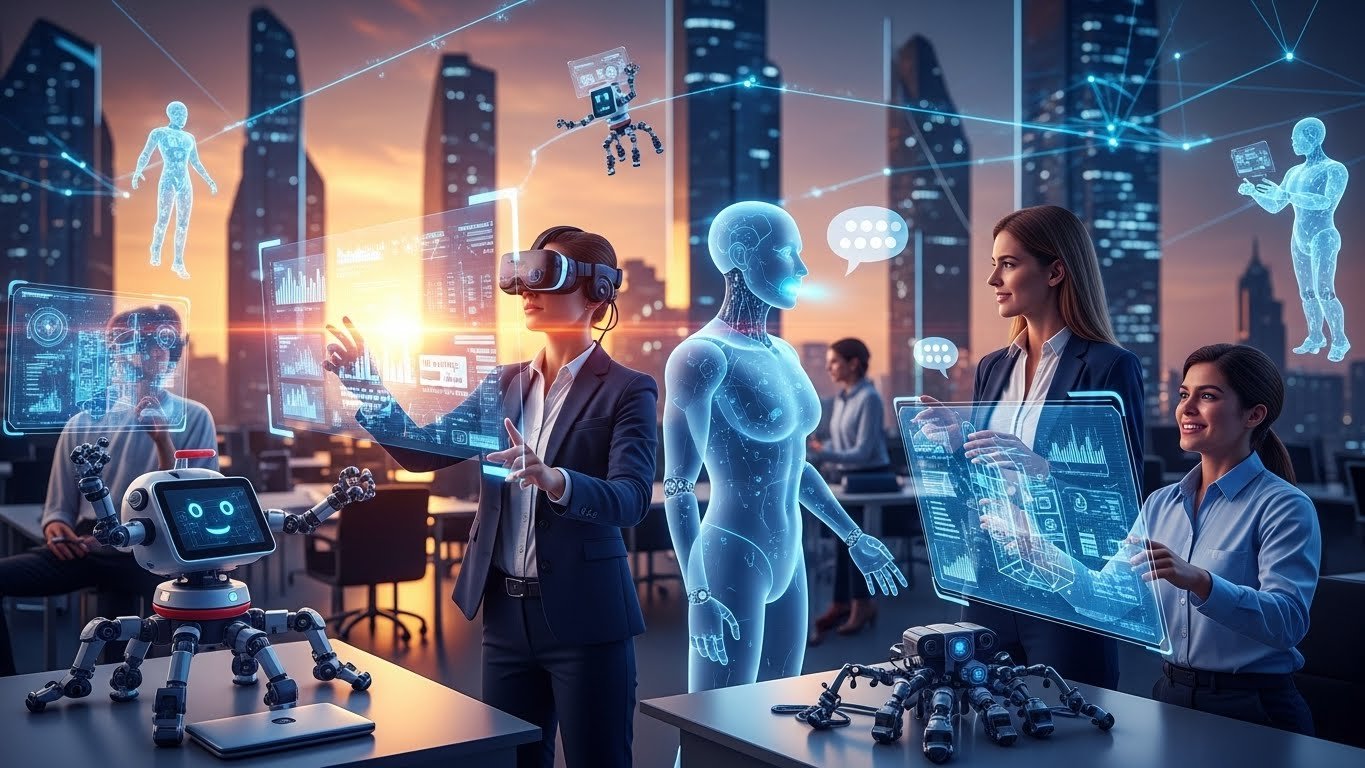
Factories, infrastructure operators, and field service teams are dealing with a reality that can’t be ignored: the workforce is shrinking, experienced technicians are retiring, and operational demands keep growing. At the same time, expectations for safety, uptime, and quality are rising. In this environment, digital transformation is no longer about adding dashboards or automating a few repetitive tasks. The next phase is about directly augmenting people, so workers can perform complex jobs with more confidence, fewer errors, and less physical and cognitive strain.
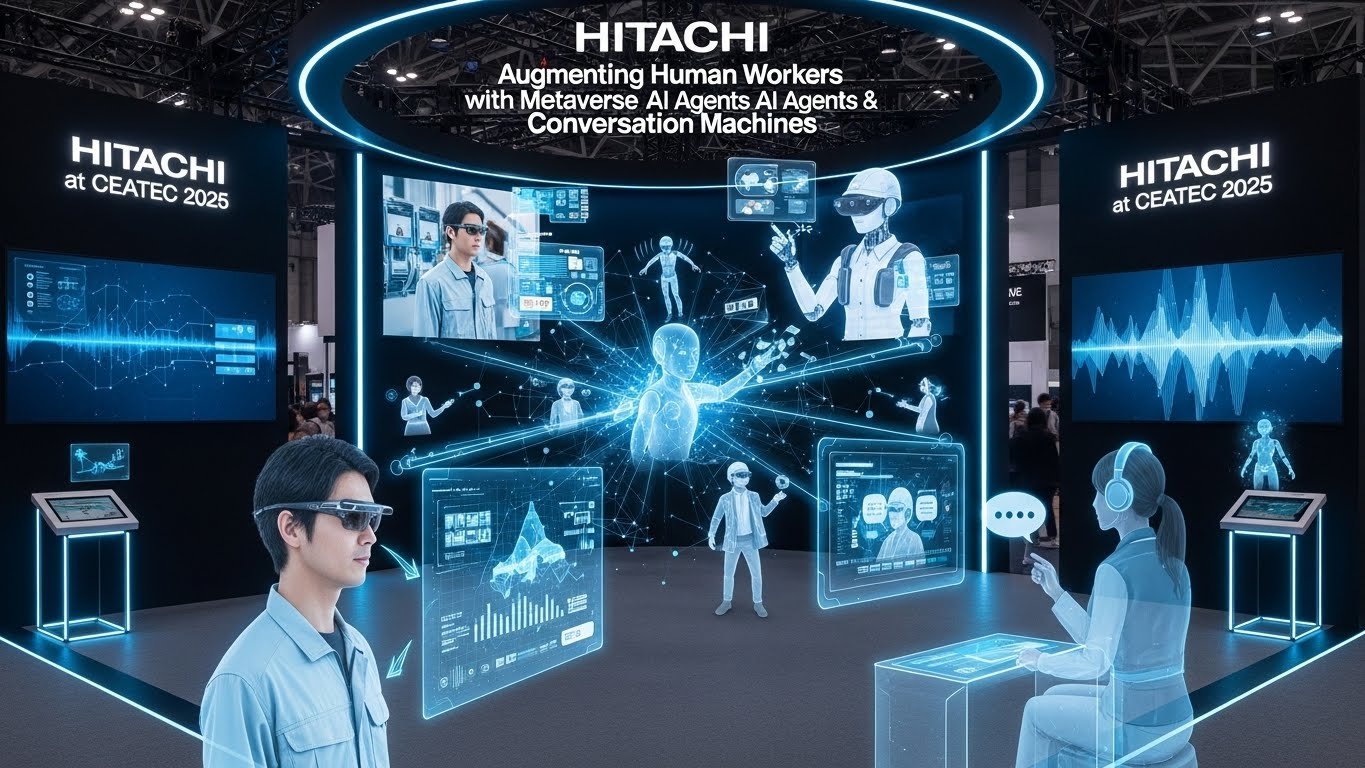
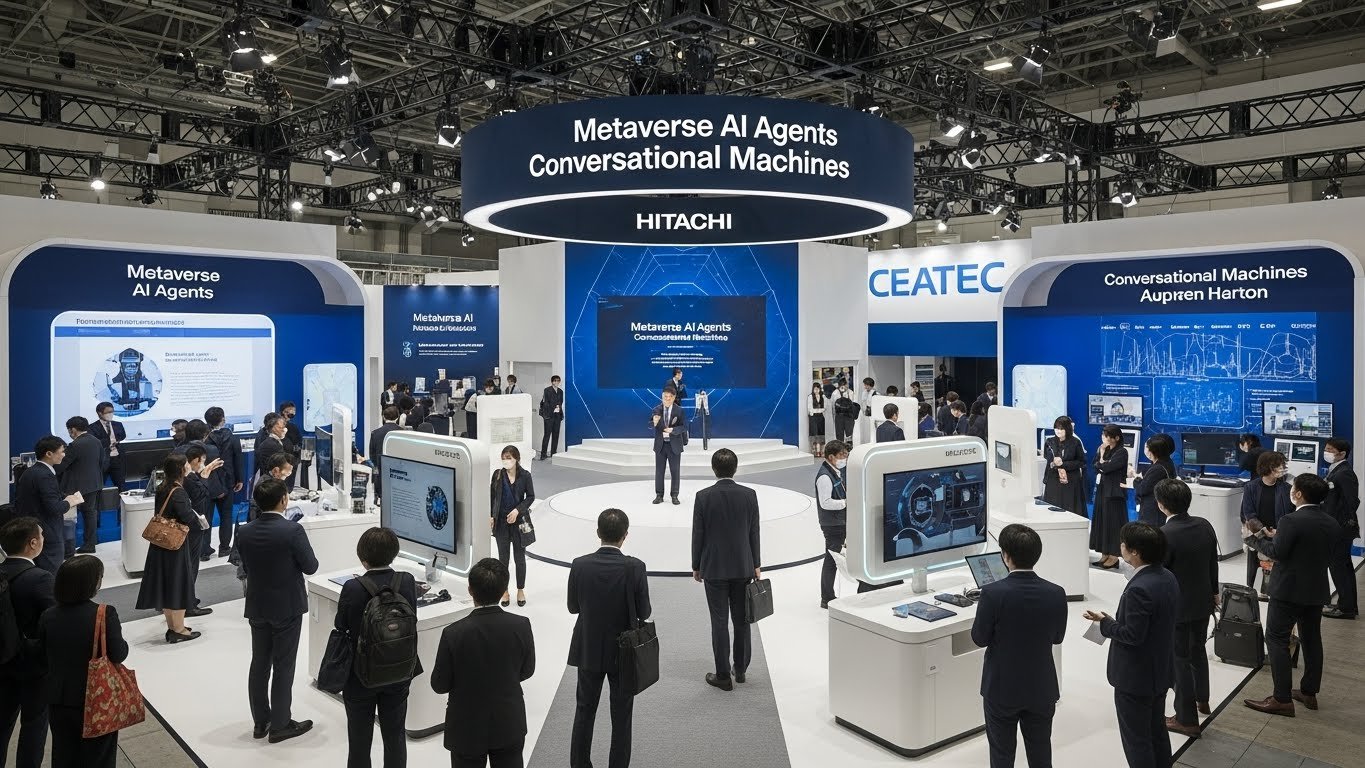
That is exactly the context behind Hitachi at CEATEC 2025, where the company highlighted a practical vision for how metaverse-driven industrial environments and AI-powered assistants can support frontline teams. Instead of presenting AI as a replacement for humans, Hitachi focused on augmentation: putting metaverse AI agents and conversational machines into real workflows so workers can plan faster, learn faster, and respond to incidents with better situational awareness.
The attention around Hitachi at CEATEC 2025 is also fueled by one central idea: industrial work is becoming too complex for knowledge to live only in the heads of a few experts. Companies need systems that preserve expertise, distribute it instantly, and deliver it in the moment of need. Metaverse spaces, digital twins, wearable sensing, and conversational interfaces can turn that idea into something operational, not theoretical.
This article explores what Hitachi at CEATEC 2025 showcased and why the combination of metaverse AI agents and conversational machines matters. You’ll learn how digital twins and immersive environments reduce mistakes, how AI agents act as real-time coordinators for frontline teams, and how conversational machines can translate complex instructions into natural language guidance. Most importantly, you’ll see why this approach is less about flashy “metaverse hype” and more about building resilient, human-centered operations that scale expertise across the workforce.
Why Hitachi at CEATEC 2025 Matters for the Future of Work
The significance of Hitachi at CEATEC 2025 lies in the fact that it addresses real constraints in the industrial world rather than chasing abstract technology trends. The manufacturing and infrastructure sectors are facing three intertwined challenges: a shortage of skilled labor, increasing safety requirements, and a growing need for flexible, data-driven operations. Traditional training programs can’t always keep up, and the knowledge gap between senior and junior workers can lead to costly delays and errors.
Hitachi at CEATEC 2025 positioned AI and immersive technology as a bridge across that gap. With industrial metaverse environments, workers can practice tasks virtually and understand the job site before arriving. AI agents that coordinate procedures, new workers can follow proven steps without relying solely on memory or a supervisor’s immediate presence. Conversational interfaces, machines become easier to operate, because the worker can ask questions naturally instead of searching manuals or navigating complicated user interfaces.
This matters because the future of work will not be defined only by automation. It will be defined by how well organizations can empower humans to handle complexity. Hitachi at CEATEC 2025 demonstrates that augmentation, when done properly, can increase productivity while also improving safety and worker wellbeing.
The Industrial Metaverse as a Worksite Reality, Not a Gimmick
How Digital Twins Become the Foundation of Augmentation
A metaverse in an industrial setting is not about avatars having meetings for fun. It is a workspace built on digital twins, sensor data, and operational models that mirror physical environments. At Hitachi at CEATEC 2025, the industrial metaverse concept is best understood as a live, interactive layer that helps workers “see” a job site and its hazards before taking action.
A digital twin can capture equipment status, environmental conditions, and spatial layouts. When this information is placed into a metaverse environment, workers can explore the site virtually, identify risky areas, and understand the sequence of tasks required. This turns training and planning into an immersive experience rather than a paper-based procedure.
The advantage of a digital twin-driven metaverse is that it reduces uncertainty. Workers are not guessing where a valve is located, how tight a space is, or which safety checks must happen first. They can walk through the job virtually and internalize the workflow before stepping onto the physical site. That is how metaverse AI agents become effective: the metaverse provides context, and the AI agent provides guidance.
Why Worksite Simulation Helps New Workers Catch Up Faster
One of the biggest reasons Hitachi at CEATEC 2025 stands out is its emphasis on supporting less experienced workers. In many industries, mastery comes from years of exposure to real jobs. But when labor shortages accelerate, companies can’t wait years for workers to reach expert level.
Metaverse simulation allows workers to learn by doing in a safe environment. They can repeat procedures, understand consequences, and build muscle memory without real-world risk. Over time, this accelerates competency development and reduces dependence on scarce veteran specialists.
When paired with AI feedback, simulation becomes even more powerful. A metaverse AI agent can monitor the worker’s choices, highlight missed safety steps, and recommend the best sequence based on established operational best practices. This combination turns training into a dynamic system rather than a static curriculum.
Metaverse AI Agents: The New “Frontline Coordinator”
From Passive Support Tools to Active Operational Partners
Many workplaces already use digital tools, but those tools often act as passive repositories. Workers must search for information, interpret it, and decide what to do next. Hitachi at CEATEC 2025 suggests a different model: AI agents that act like active partners, coordinating tasks in real time.
A metaverse AI agent can interpret sensor inputs, work schedules, and operational rules. It can then guide workers step by step, predict possible risks, and recommend preventive actions. This is a major shift, because it changes the role of digital systems from “information providers” to “decision-support partners.”
The key is that these agents are not replacing workers. They are reducing cognitive load, helping workers focus on what humans do best: judgment, adaptability, and hands-on execution. In other words, Hitachi at CEATEC 2025 shows AI as a practical augmentation layer that makes humans more capable.
Proactive Safety Guidance and Hazard Prediction
Safety is where AI agents can deliver immediate value. A frontline worker often operates in environments where hazards are not always visible. If the worker is under time pressure or fatigued, the risk increases.
Hitachi at CEATEC 2025 explored AI-driven safety support by combining wearable sensing, digital twin mapping, and AI interpretation. In an ideal workflow, a metaverse AI agent can identify hazardous zones, verify that procedures are being followed, and alert the worker before they enter a risky area. This can dramatically reduce the likelihood of accidents, especially for new staff who may not recognize subtle danger signals.
In this sense, the metaverse AI agent becomes a real-time safety companion, translating raw sensor data into understandable warnings and recommended actions. This is not theoretical. It is the logical next step when you have connected worksites, reliable sensing, and AI models trained on safety rules and incident patterns.
Conversational Machines: Turning Equipment Into a Dialogue Partner
Why Natural Language Interfaces Are Critical in Industrial Work
Complex equipment is often controlled through specialized panels and software. While experts can navigate these interfaces quickly, they can overwhelm new workers. This is a major productivity bottleneck and a training burden.
Hitachi at CEATEC 2025 emphasized conversational machines, where workers can interact with equipment or operational systems using natural language. Instead of digging through manuals or menus, the worker can ask, “What’s the next step?” or “Why is this alert happening?” and receive a clear response.
The value here is speed and clarity. In fast-moving environments, workers need immediate answers. Conversational machines reduce delays, reduce errors caused by misunderstanding, and make complex operations more accessible to a wider workforce.
That is why conversational AI is becoming a core element of augmentation. It doesn’t just make systems easier to use; it lowers the barrier to competence.
Conversations That Carry Context, Not Just Commands
Not all conversational interfaces are equal. A weak system can answer simple questions but fail when context matters. A strong system understands the job, the machine state, and the worker’s role.
Hitachi at CEATEC 2025 pointed toward conversational machines that operate with context awareness. This means the system can reference the digital twin, interpret sensor readings, and align responses with safety procedures. For example, if a worker asks how to restart a system, the conversational machine can first verify whether a safety lockout is required and then guide the worker through compliant steps.
This is where context-aware AI, human-machine collaboration, and industrial knowledge graphs become essential. The conversational machine isn’t just a chatbot. It is an operational interface that merges expertise with real-time system understanding.
How Metaverse AI Agents and Conversational Machines Work Together
The Augmentation Loop: Observe, Predict, Guide, Improve
The core insight of Hitachi at CEATEC 2025 is that augmentation works best as a loop. The system observes worksite conditions through sensors and operational data. It predicts risks or inefficiencies through AI models. It guides workers through metaverse AI agents and conversational machines. Then it improves continuously as new data is generated.
When these elements connect, the workplace becomes smarter over time. Procedures become more refined, training becomes more personalized, and safety programs become more predictive. This is why Hitachi’s approach is compelling: it treats augmentation as a living system rather than a one-time deployment.
Digital Expertise Transfer at Scale
Organizations often struggle to transfer knowledge from experts to new workers. Manuals are too generic, training is expensive, and experts can’t be everywhere at once.
Hitachi at CEATEC 2025 showed how metaverse AI agents can store and deliver expertise through virtual procedures and interactive guidance. Conversational machines then deliver that knowledge at the moment of need, when the worker asks a question or faces an alert. In effect, expertise becomes a service embedded into daily work. This is one of the most practical benefits of the approach. It doesn’t require every worker to become an expert overnight. Instead, it makes expert-level support available in real time, which increases productivity and reduces stress.
Business Impact: Productivity, Quality, and Workforce Sustainability
Faster Onboarding and Reduced Training Costs
One of the most direct outcomes of the technology shown in Hitachi at CEATEC 2025 is faster onboarding. Instead of relying on classroom instruction alone, workers learn through immersive simulation and real-time assistance. This reduces the time required to reach basic competence and decreases reliance on busy supervisors. From a business standpoint, this is crucial. In industries with high turnover or rapid expansion, training is a constant cost center. By using immersive training, digital twins, and AI-guided workflows, companies can reduce training overhead while maintaining quality.
Fewer Errors and Higher Operational Consistency
Quality failures are often linked to human error, especially when procedures are complex or when workers are inexperienced. By guiding workers step by step, metaverse AI agents can reduce procedural deviations. By allowing workers to ask conversational questions, machines can prevent misunderstandings before they become mistakes. Hitachi at CEATEC 2025 effectively highlighted how this can create consistency across shifts, teams, and locations. Instead of relying on informal knowledge sharing, companies can standardize best practices in a living digital system.
Supporting Workers Without Burning Them Out
Augmentation is not only about productivity. It is also about human sustainability. Many frontline roles are physically demanding and mentally stressful, especially when mistakes carry safety risks. Metaverse AI agents reduce the mental burden of decision-making under uncertainty by offering structured guidance. Conversational machines reduce frustration by providing clear answers. Wearable sensing can help identify fatigue patterns or risky conditions early. When these systems are designed ethically, they become tools that support workers rather than surveillance mechanisms. Hitachi at CEATEC 2025 suggests a future where technology helps workers feel safer, more confident, and more capable rather than replaced.
Challenges and What Must Be Done Right
Trust, Transparency, and Worker Acceptance
No augmentation system succeeds if workers don’t trust it. If AI guidance feels unreliable, intrusive, or punitive, adoption will stall. Hitachi at CEATEC 2025 highlights the need for transparent design. Workers must understand why the AI is recommending a step, how hazard predictions are made, and how data is used. Organizations must position augmentation as support, not monitoring. This is where explainable AI, privacy-by-design, and human-centered AI become non-negotiable for real-world success.
Integration With Legacy Systems and Real Workflows
Industrial sites are filled with legacy equipment and systems. Augmentation tools must integrate without forcing organizations to rebuild everything from scratch. For Hitachi’s model to scale, metaverse digital twins must connect to existing operational data sources, and conversational machines must interface with real equipment control systems. The goal is to create a seamless layer that improves work without disrupting operations.
Avoiding Over-Reliance and Preserving Human Judgment
A final challenge is the risk of over-reliance on AI guidance. If workers become too dependent, critical thinking can weaken. The best augmentation systems are designed to support learning, not replace it. Hitachi at CEATEC 2025 points toward tools that coach workers, explain reasoning, and gradually build expertise. That is how augmentation becomes empowering rather than limiting.
Conclusion
Hitachi at CEATEC 2025 shows a clear shift in how industrial technology is evolving. The future is not simply about automation, and it’s not simply about AI replacing human roles. It’s about metaverse AI agents and conversational machines augmenting human workers so they can operate safely, efficiently, and confidently in increasingly complex environments.
By combining industrial metaverse digital twins with AI agents that coordinate tasks and conversational machines that turn equipment into dialogue partners, Hitachi is building a model where knowledge is always available, training is immersive, and safety becomes proactive. This approach directly addresses the realities of workforce shortages, rising safety standards, and the growing need for operational resilience.
If implemented with transparency, ethical data practices, and strong integration into real workflows, the technologies highlighted through Hitachi at CEATEC 2025 can help industries scale expertise, reduce errors, and protect the wellbeing of workers. That is what augmentation should mean: not replacing humans, but making human work stronger, safer, and more sustainable.
FAQs
Q: How did Hitachi at CEATEC 2025 demonstrate metaverse AI agents augmenting human workers in real workplaces?
Hitachi at CEATEC 2025 demonstrated metaverse AI agents as digital coordinators that guide workers through complex procedures using immersive worksite environments and real-time operational data. Instead of treating AI as a separate analytics tool, the approach places AI inside the workflow, where it can verify safety steps, recommend the next action, and help less experienced workers navigate tasks with confidence. The metaverse layer provides spatial context through digital twins, while the AI agent transforms that context into step-by-step assistance that reduces cognitive load and improves consistency.
Q: What makes conversational machines different from normal chatbots in industrial environments?
Conversational machines go beyond generic question-and-answer chatbots because they are designed to understand machine state, operational context, and safety procedures. In industrial settings, context is everything, and a conversational machine must interpret alerts, equipment conditions, and workflow steps before providing guidance. At Hitachi at CEATEC 2025, conversational machines are positioned as natural language interfaces that help workers operate equipment more safely and efficiently, turning complex controls into accessible dialogue that supports faster decisions and fewer mistakes.
Q: Why are metaverse digital twins important for safety and training, not just visualization?
Metaverse digital twins are important because they can mirror real worksites using sensor data, spatial models, and operational rules. This allows workers to practice procedures in a safe simulation, identify hazard zones, and understand the job before they arrive on-site. At Hitachi at CEATEC 2025, the metaverse digital twin acts as the foundation for AI guidance, enabling hazard prediction and safety verification that would be difficult with text manuals alone. The result is training that builds muscle memory and safety awareness without real-world risk.
Q: How can companies adopt the Hitachi at CEATEC 2025 approach without disrupting existing legacy operations?
Companies can adopt augmentation gradually by integrating digital twin models with existing operational data sources, then layering metaverse planning and conversational assistance on top of current workflows. The key is to treat AI agents and conversational machines as support tools that connect to legacy systems rather than replacing them overnight. A phased rollout can start with high-risk procedures where safety gains are immediate, then expand to broader operations once workers and managers build trust in the system’s reliability and value.
Q: What are the biggest risks of using AI agents and conversational machines to augment workers, and how can they be reduced?
The biggest risks include worker mistrust, privacy concerns, and over-reliance on AI guidance that could weaken human judgment. These risks can be reduced through transparent communication, explainable AI that shows why a recommendation is made, and strict privacy-by-design principles that ensure data is used to support workers rather than monitor them unfairly. Training should also emphasize that AI is a partner, not a replacement, and systems should be designed to teach workers as they guide them, so human expertise grows alongside the technology.
