

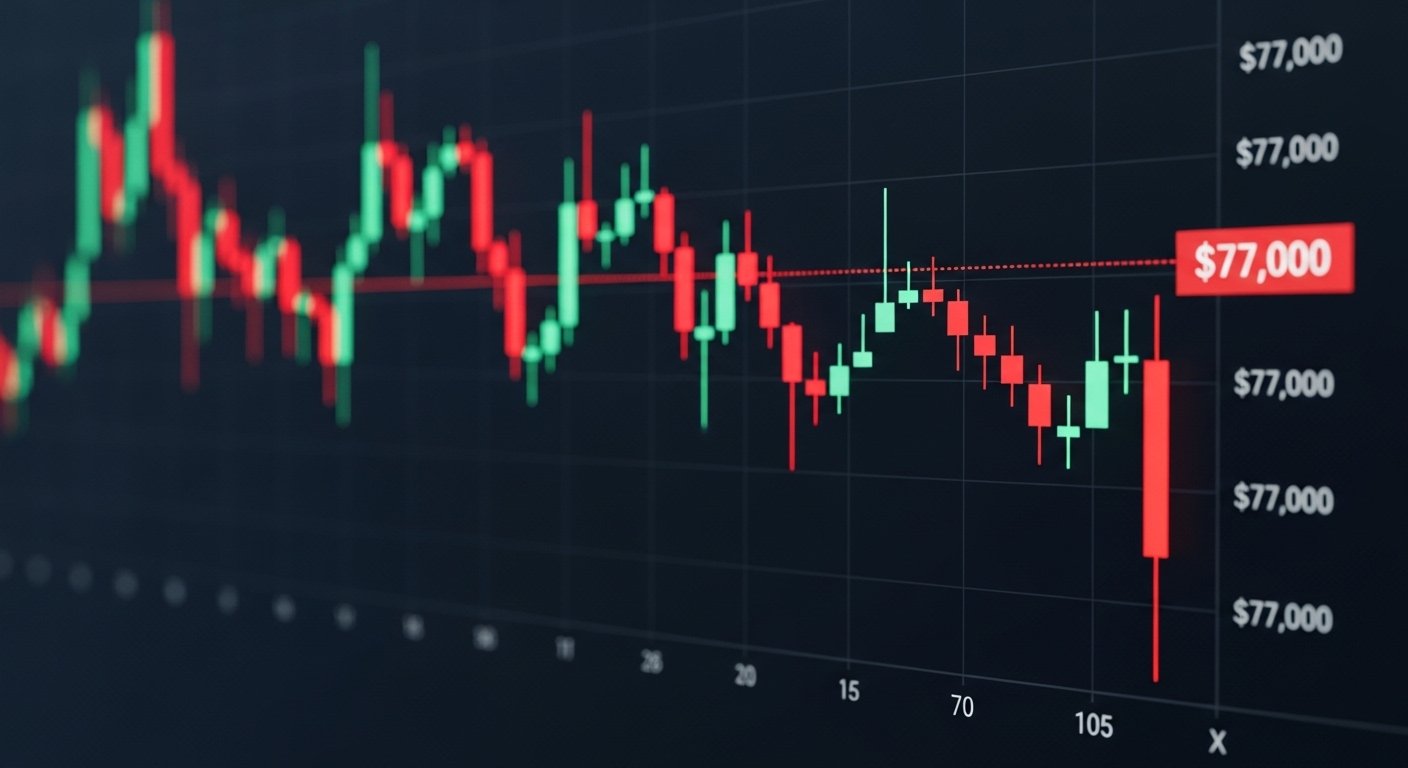
The latest attempt by Bitcoin to rebound has run into a problem traders know too well: follow-through. After showing early signs of recovery, the Bitcoin price failed to hold momentum and slipped back toward $77,000, reminding the market that bounces can be fragile when confidence is shaky. At the same time, precious metals renewed their surge, with gold grabbing attention as investors sought perceived safety. This divergence—crypto weakening while gold strengthens—has sparked fresh debate about how markets are pricing risk, inflation, and uncertainty, and whether the narrative of “digital gold” is being challenged in real time.
When a Bitcoin bounce fails, it often reflects more than a simple lack of buyers. It can indicate that sellers are still in control, that liquidity is thin, or that the market is responding to broader macro conditions such as higher yields, a stronger dollar, or a defensive shift in portfolios. A failed bounce can also be a psychological event. Traders who bought the dip expecting quick upside may rush to exit when the rally stalls, adding fresh selling pressure. That can push Bitcoin back toward widely watched levels like $77,000, where the market tests whether support is real or simply temporary.
Meanwhile, the renewed surge in precious metals offers a different kind of message. Gold and its peers tend to attract flows when investors are nervous about economic instability, geopolitical risk, or long-term purchasing power. When gold rises as Bitcoin falls, it can signal that the market is prioritizing traditional safe havens over newer risk assets. That doesn’t mean crypto is “finished,” but it does suggest that in this moment, capital is choosing stability and history over volatility and innovation.
This article breaks down why the Bitcoin bounce fails narrative matters, what could be driving the drop back to $77,000, why precious metals are surging again, and how investors can interpret the relationship between crypto and safe-haven assets. You’ll also find key signals to watch next, practical risk-management guidance, and five FAQs after the conclusion.
Why the Bitcoin Bounce Failed: What the Market May Be Signaling
A Bitcoin bounce fails when buyers can’t maintain upward pressure and price rolls over, often after testing a key resistance area. This pattern commonly appears in risk-off periods because traders treat rallies as opportunities to reduce exposure rather than expand it. When that happens repeatedly, it creates a downtrend structure: lower highs and weaker recoveries.
One reason a Bitcoin bounce fails is positioning. If a large number of traders enter long positions during the rebound, price becomes fragile. A small decline can trigger stop-loss orders and liquidations, accelerating the move lower. Another reason is simple demand: if institutional and spot buyers do not step in with conviction, rebounds can fade quickly once short covering ends.
A failed bounce also reflects market psychology. When traders expect a strong recovery and it doesn’t appear, confidence drops fast. That lack of confidence can keep Bitcoin price action heavy and lead to repeated retests of support zones like $77,000.
Bitcoin Falls Back to $77,000: Why This Level Matters
The $77,000 zone matters because round numbers often become psychological reference points, and because major support and resistance levels tend to form where trading activity previously concentrated. When Bitcoin falls back to $77,000 after a rebound attempt, it can create a “decision point” for the market.
If buyers defend $77,000 and price stabilizes, it can suggest the pullback is a normal retest and that a base may be forming. If $77,000 breaks decisively, it may signal that the broader downtrend is still active and that the market may search for deeper support. In either case, the return to $77,000 reinforces a key message: the rebound did not shift market control from sellers to buyers.
For traders, this is where risk management becomes critical. A Bitcoin bounce fails pattern can trap late buyers, while disciplined traders wait for confirmation—either a clear reclaim of resistance or a stable consolidation that proves sellers are weakening.
The Precious Metals Surge: Why Gold Is Winning the Safe-Haven Contest
Investors Rotate Toward Traditional Safety
A renewed surge in precious metals often reflects a shift toward capital preservation. When uncertainty rises, gold tends to benefit because it is widely recognized, deeply liquid, and historically viewed as a store of value. In risk-off environments, many investors choose assets that have decades—or centuries—of trust behind them.
This rotation can happen quickly when markets sense instability. As portfolios become more defensive, allocations flow toward gold, sometimes at the expense of risk assets. That can leave Bitcoin struggling, especially if investors treat it more like a speculative instrument than a safe haven during the current macro regime.
Inflation, Rates, and the Value Narrative
Gold’s strength is often linked to inflation concerns and real-rate dynamics. When investors worry about purchasing power or long-term fiscal trends, precious metals can attract demand. Bitcoin also has an inflation-hedge narrative, but it is younger and more volatile, so the market may not always treat it the same way in the short run.
When gold surges while Bitcoin price weakens, it suggests the market is rewarding stability and tradition over digital scarcity narratives—at least for now.
Bitcoin vs Gold: Why the “Digital Gold” Narrative Can Diverge
Different Perceptions of Risk
Bitcoin can act like “digital gold” in some contexts, but in many market regimes it trades like a high-beta risk asset. Gold tends to rise when fear rises. Bitcoin can rise in fear-driven moments too, but it often falls when liquidity tightens. That’s a crucial distinction.
A Bitcoin bounce fails while gold rallies can indicate that investors are treating Bitcoin as a risk exposure rather than a safe haven, especially if the broader market is de-leveraging. In other words, Bitcoin’s long-term narrative may remain intact, but its short-term behavior is still heavily influenced by risk sentiment.
Volatility and Portfolio Construction
From a portfolio perspective, gold’s lower volatility makes it easier to hold during uncertain periods. Bitcoin’s higher volatility makes it harder for risk-managed funds to maintain exposure when markets get choppy. If volatility rises, systematic strategies may reduce Bitcoin exposure, adding pressure to the Bitcoin price while gold benefits from inflows.
Liquidity Preference in Stress
During stress, investors prefer assets that can be sold or hedged easily with less slippage. Gold has mature market infrastructure. Bitcoin is liquid, but crypto liquidity can thin quickly during sudden moves. That difference can make gold the “default” haven when precious metals surge and crypto sentiment weakens.
Macro Forces Behind the Divergence: Stocks, Yields, and the Dollar
Risk-Off Sentiment Across Markets
A broader risk-off mood can cause investors to reduce exposure to speculative assets. In that environment, a Bitcoin bounce fails more easily because buyers are cautious and sellers remain active. Gold, meanwhile, can rise because it fits the defensive posture.
Higher Yields and Opportunity Cost
When bond yields are attractive, the opportunity cost of holding volatile assets can increase. That can weaken demand for Bitcoin and support gold’s relative appeal depending on real-rate expectations and hedging demand.
Dollar Strength and Global Liquidity
A stronger dollar can pressure dollar-priced risk assets, including Bitcoin. Gold’s reaction can be more nuanced, but it often benefits when uncertainty rises and investors seek hedges. If global liquidity tightens, Bitcoin can struggle more, increasing the chance that a Bitcoin bounce fails.
Market Mechanics: Why Bounces Fail in Crypto
Short Covering Isn’t the Same as Real Demand
Many rebounds start with short covering—traders buying back positions to lock in profits. That can lift price quickly. But once short covering fades, the market needs real demand to continue rising. If it doesn’t arrive, the Bitcoin bounce fails and price slips back.
Leverage, Liquidations, and Stop Cascades
Crypto markets can be heavily influenced by leverage. When price turns down after a bounce, stop-loss orders and liquidation thresholds can cascade, pushing Bitcoin price lower faster than expected. This mechanical selling can make the move back to $77,000 look sudden.
Thin Liquidity at Key Levels
Liquidity often clusters around major price levels. If price approaches a level like $77,000 and order books are thin, a relatively modest wave of selling can move the market quickly. That can reinforce the sense that the Bitcoin bounce fails because support doesn’t appear immediately.
What Traders and Investors Should Watch Next
Key Technical Signals
After a decline back to $77,000, traders typically watch whether Bitcoin forms higher lows or continues making lower highs. A stable base often requires time and repeated defenses. A breakdown suggests the downtrend is still active.
Volume and Volatility
If selling volume fades and volatility begins to compress, it can suggest stabilization. If volume spikes on red candles and volatility expands, it can indicate more stress. These signals help traders interpret whether the drop is temporary or part of a deeper move.
Correlation With Risk Assets and Safe Havens
Watching how Bitcoin correlates with stocks and gold can reveal which narrative is dominant. If Bitcoin trades like a risk asset, a stock selloff may keep pressure on Bitcoin price. If it begins to decouple, it may suggest a shift in market perception.
Precious Metals Momentum
The strength of precious metals can be a clue about broader market fear. If gold continues to surge, it may indicate persistent uncertainty, which can keep risk assets—including Bitcoin—under pressure.
Practical Strategies in a Market Where the Bitcoin Bounce Fails
Avoid Chasing Green Candles
When a Bitcoin bounce fails repeatedly, chasing rallies can be costly. A disciplined approach often involves waiting for confirmation: either a clear break and hold above resistance or a consolidation pattern that proves sellers are weakening.
Manage Risk With Position Sizing
Volatility is the tax you pay for opportunity. When markets are unstable, smaller positions can reduce emotional decision-making. This is especially important when Bitcoin is retesting key levels like $77,000.
Separate Long-Term Thesis From Short-Term Noise
Long-term believers in Bitcoin’s scarcity and adoption story can still acknowledge that short-term price action is driven by liquidity and sentiment. A Bitcoin bounce fails does not automatically invalidate the thesis, but it does require patience and risk control.
Don’t Ignore Cross-Market Signals
Crypto doesn’t live in a vacuum. If precious metals are surging and stocks are weak, the market may be sending a clear message: risk appetite is low. Respecting that message can help avoid unnecessary losses.
Conclusion
Bitcoin’s retreat back to $77,000 after a rebound attempt underscores a market environment where buyers are cautious and sellers remain active. When a Bitcoin bounce fails, it often signals that the rally was driven more by positioning and short covering than by durable demand. At the same time, the renewed surge in precious metals—especially gold—suggests that investors are leaning defensive, prioritizing assets with long-established safe-haven status.
This divergence doesn’t settle the debate about Bitcoin’s long-term role, but it does clarify the current regime: uncertainty is being priced in, volatility remains high, and traditional safety is attracting flows. For traders, the focus should be on confirmation, liquidity, and risk control around key zones like $77,000. For investors, the focus should be on time horizon, allocation discipline, and understanding that short-term narratives can shift quickly while long-term adoption trends evolve more slowly. If risk sentiment improves and Bitcoin proves it can hold higher lows, the story can change. Until then, the market is rewarding caution—and gold is taking center stage.
FAQs
Q: Why did the Bitcoin bounce fail and fall back to $77,000?
A Bitcoin bounce fails when buying momentum fades and sellers regain control. This can happen due to weak spot demand, leverage unwinds, or traders selling rallies in a risk-off environment, pushing Bitcoin price back toward key support.
Q: Why are precious metals surging while Bitcoin is falling?
Precious metals often attract demand during uncertainty because they are viewed as traditional safe havens. If investors reduce risk exposure, they may rotate into gold while trimming volatile assets like Bitcoin.
Q: Does this mean Bitcoin is no longer “digital gold”?
Not necessarily. Bitcoin can behave like “digital gold” over long horizons, but in many short-term stress periods it trades like a risk asset. A Bitcoin bounce fails during a gold surge reflects current sentiment more than a final verdict on the narrative.
Q: What levels should traders watch after Bitcoin returns to $77,000?
Traders typically watch whether Bitcoin holds support near $77,000 and whether it can reclaim nearby resistance zones. Stable consolidation and higher lows can support recovery, while repeated breakdowns can signal continued weakness.
Q: What’s the safest approach during this kind of market divergence?
Focus on risk management: avoid chasing rallies if the Bitcoin bounce fails pattern persists, reduce position size during high volatility, and monitor cross-market signals like stocks and precious metals for clues about risk appetite.
