


Currently trading nearly 30% below its all-time high, many investors are questioning whether this signals the end of the bull run or simply a routine pause in the upward trajectory. However, a comprehensive analysis of Bitcoin price correction patterns throughout the digital asset’s 15-year history reveals a reassuring pattern: these substantial drawdowns are not anomalies but rather normal market behavior that has consistently preceded new highs.
Understanding the cyclical nature of Bitcoin price correction events is crucial for both seasoned investors and newcomers navigating the tumultuous crypto waters. This article examines historical data, market psychology, and expert insights to demonstrate why the current 30% decline falls well within the bounds of typical Bitcoin market behavior.
Bitcoin Price Correction Cycles
What Defines a Bitcoin Price Correction?
A Bitcoin price correction occurs when the cryptocurrency’s value declines by 10% or more from its recent peak. In traditional financial markets, corrections are generally defined as pullbacks between 10% and 20%, while declines exceeding 20% are classified as bear markets. However, Bitcoin’s inherent volatility means that corrections often exceed these traditional thresholds without necessarily indicating a prolonged downturn.
The current 30% decline represents what technical analysts call a “healthy correction” within an ongoing bull market. These temporary price reductions serve several important market functions: they allow overheated conditions to cool, shake out overleveraged positions, and provide entry opportunities for new investors who missed earlier price levels.
The Psychology Behind Crypto Market Pullbacks
Market psychology plays a pivotal role in Bitcoin price correction events. When prices surge rapidly, euphoria takes hold, attracting late-stage investors driven by fear of missing out (FOMO). This creates unsustainable price levels that inevitably correct. The subsequent decline triggers panic selling, amplifying the downward momentum until prices reach levels where long-term holders view the asset as undervalued.
This cyclical pattern of greed and fear has repeated throughout Bitcoin’s history, creating predictable waves of expansion and contraction. Understanding this psychology helps investors maintain perspective during volatile periods and avoid making emotional decisions that often lead to selling at the bottom.
Historical Bitcoin Price Correction Analysis
Major Corrections Throughout Bitcoin’s History
Bitcoin’s price history is punctuated by numerous significant corrections that dwarf the current 30% decline. A comprehensive examination of these historical events provides valuable context for today’s market conditions.
2011: The First Major Crash. After reaching approximately $32 in June 2011, Bitcoin plummeted over 93% to around $2 by November 2011. This devastating crypto market pullback lasted several months but ultimately proved temporary. Bitcoin eventually recovered and surpassed its previous high.
2013: Two Major Corrections The year 2013 witnessed two significant corrections. The first occurred in April when Bitcoin crashed from $266 to $50 (an 81% decline). The second happened in December, when, after reaching $1,150, Bitcoin fell approximately 87% to $152 by January 2015.
2017-2018: The ICO Boom and Bust Perhaps the most famous Bitcoin price correction occurred following the 2017 bull run. After reaching nearly $20,000 in December 2017, Bitcoin entered a prolonged bear market, ultimately declining approximately 84% to $3,200 by December 2018.
2021-2022: Post-Pandemic Correction Following its April 2021 peak of approximately $64,000, Bitcoin experienced multiple corrections, including a 56% decline to $28,000 in July 2021, before recovering to a new all-time high of $69,000 in November 2021. The subsequent bear market saw Bitcoin fall to approximately $15,500 in November 2022, representing a 77% decline.
Correction Patterns and Recovery Times
Analysis of these historical corrections reveals several consistent patterns:
Correction Depth: Most Bitcoin corrections within bull markets range from 20% to 40%, while bear market declines typically exceed 50% and can reach 80% or more.
Recovery Duration: Bull market corrections typically resolve within weeks to months, while bear market recoveries can take 12-24 months or longer.
New Highs: Following every major Bitcoin price correction in history, Bitcoin has eventually reached new all-time highs, rewarding patient long-term holders.
The current 30% decline falls comfortably within the parameters of a bull market correction rather than a bear market crash, suggesting potential for recovery and continuation of the broader uptrend.
Why Bitcoin Corrections Are Normal Market Behavior
Volatility Is Built Into Bitcoin’s DNA
Bitcoin volatility stems from several fundamental characteristics of the cryptocurrency. With a fixed supply of 21 million coins and a relatively small market capitalization compared to traditional assets like gold or major fiat currencies, Bitcoin is susceptible to significant price swings from large transactions or shifts in investor sentiment.
The 24/7 trading schedule, global accessibility, and lack of circuit breakers that halt trading during extreme moves all contribute to Bitcoin’s propensity for dramatic crypto market pullbacks. Unlike traditional stock markets that close overnight and on weekends, Bitcoin never sleeps, allowing momentum in either direction to build continuously.
Leverage and Liquidations Amplify Moves
The cryptocurrency derivatives market has grown exponentially, with billions of dollars in leveraged positions frequently open on major exchanges. When prices move sharply in either direction, these leveraged positions face liquidation, creating cascading effects that amplify the initial price movement.
During corrections, long positions are liquidated, forcing the automatic sale of Bitcoin, which drives prices lower and triggers additional liquidations. This domino effect can result in rapid declines of 20-30% within days or even hours, only for prices to stabilize once the excess leverage is flushed from the system.
Profit-Taking by Early Investors
As Bitcoin appreciates significantly from lower levels, early investors and miners naturally take profits, creating selling pressure. This profit-taking is a healthy market function that redistributes Bitcoin from strong hands to new investors, broadening ownership and increasing market maturity.
Major Bitcoin price correction events often coincide with significant unrealized profits across the network. When a large percentage of holders are sitting on substantial gains, the temptation to secure profits increases, leading to coordinated selling that manifests as corrections.
Regulatory Uncertainty and Macro Factors
External factors frequently trigger or exacerbate Bitcoin corrections. Regulatory announcements, government crackdowns on cryptocurrency exchanges, changes in monetary policy, or broader economic uncertainty can all prompt rapid sell-offs.
However, Bitcoin has demonstrated remarkable resilience in recovering from regulatory setbacks. Bans in major markets like China initially caused panic selling, but prices eventually recovered as the market adapted and trading activity shifted to more friendly jurisdictions.
Current Bitcoin Market Conditions Analysis
On-Chain Metrics Suggest Healthy Correction
Several key on-chain metrics provide insight into whether the current Bitcoin price correction represents a buying opportunity or the beginning of a prolonged downturn. Current data suggests the former.
Exchange Balances: The amount of Bitcoin held on exchanges has been declining, indicating that investors are moving coins to cold storage for long-term holding rather than preparing to sell. This behavior typically occurs during bull market corrections rather than bear market beginnings.
Holder Behavior: Long-term holder (LTH) metrics show that wallets holding Bitcoin for over six months are generally not selling into the current weakness. This “HODLing” behavior demonstrates conviction among experienced investors that current prices represent value.
Network Activity: Despite the price decline, Bitcoin network activity remains robust, with transaction counts and hash rate (network security) near all-time highs. Strong fundamental network metrics during price corrections often precede recoveries.
Institutional Investment Continues
Unlike previous crypto market pullbacks, the current correction is occurring in an environment of increasing institutional adoption. The approval of spot Bitcoin ETFs in the United States has created new access channels for traditional investors, and inflows to these products have remained relatively stable despite the price decline.
Major corporations continue to add Bitcoin to their treasury holdings, and financial institutions are expanding their cryptocurrency service offerings. This institutional infrastructure was largely absent during previous bear markets, potentially providing a stronger support base for prices.
Macroeconomic Backdrop
The broader macroeconomic environment significantly influences Bitcoin’s price action. Current factors include:
Interest Rates: Central bank policies on interest rates affect risk asset valuations, including Bitcoin. Higher rates have historically pressured cryptocurrency prices, while rate cuts or pauses often correlate with crypto rallies.
Inflation Concerns: Bitcoin’s fixed supply and deflationary monetary policy make it attractive during periods of currency devaluation, supporting long-term demand despite short-term volatility.
Traditional Market Correlation: Bitcoin’s correlation with technology stocks and broader risk assets has increased in recent years. When tech stocks decline, Bitcoin often follows, and vice versa.
What History Teaches Long-Term Bitcoin Investors
The Power of Holding Through Volatility
Historical analysis overwhelmingly supports a long-term holding strategy for Bitcoin investors. Despite numerous corrections exceeding 30%, including several catastrophic declines of 80% or more, Bitcoin has consistently recovered to reach new all-time highs.
An investor who purchased Bitcoin at the 2017 peak of $20,000 and held through the subsequent 84% decline would have seen their investment eventually triple when Bitcoin reached $69,000 in 2021. Even purchasing at the 2021 peak of $69,000, while currently underwater, history suggests patience will likely be rewarded.
The key lesson from Bitcoin price correction history is that timing the market perfectly is nearly impossible, but time in the market has consistently rewarded patient investors willing to endure volatility.
Dollar-Cost Averaging Reduces Timing Risk
Rather than attempting to buy the absolute bottom of corrections, many successful Bitcoin investors employ dollar-cost averaging (DCA). This strategy involves making regular, fixed-size purchases regardless of price, which smooths out entry points and eliminates the emotional stress of timing decisions.
During crypto market pullbacks, DCA automatically increases Bitcoin accumulation as prices decline, lowering the average cost basis. When prices recover, these lower-cost purchases significantly enhance returns.
The Halvening Cycle Pattern
Bitcoin’s programmed supply schedule includes “halvening” events approximately every four years, when the reward for mining new blocks is cut in half. These events have historically preceded major bull markets, with prices typically peaking 12-18 months after each halving, followed by a correction and bear market.
The most recent halving occurred in April 2024, suggesting that if historical patterns hold, Bitcoin may be in the middle of a multi-year bull market. The current 30% Bitcoin price correction would represent a normal mid-cycle pullback rather than the end of the upward trend.
Common Mistakes During Bitcoin Corrections
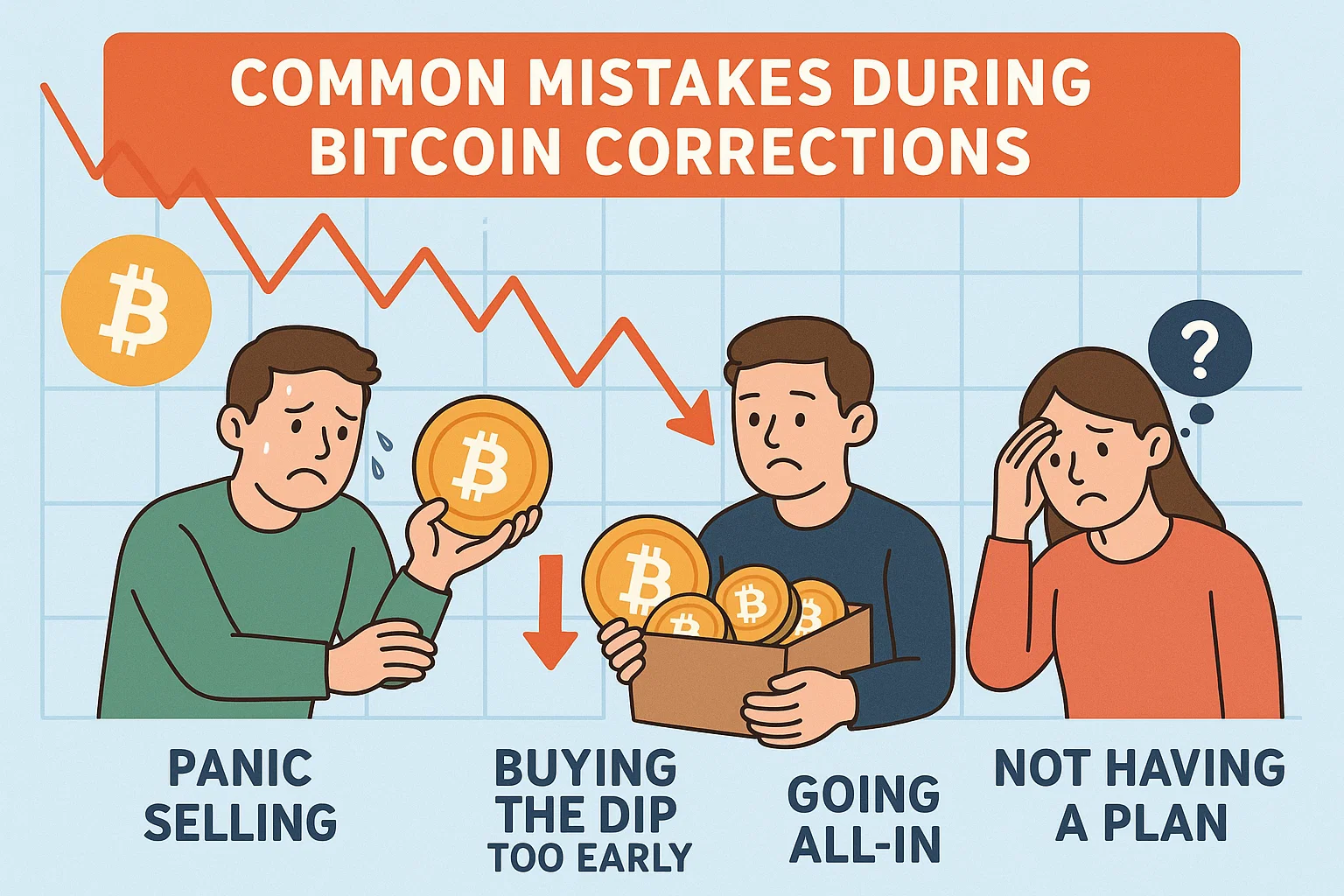
Panic Selling at the Bottom
The most costly mistake investors make during Bitcoin price correction events is panic selling near the bottom. Emotional decision-making driven by fear leads to realizing losses that would have been temporary paper losses if positions were held.
Market bottoms are characterized by maximum fear and pessimism, when negative news dominates headlines, and even experienced investors question Bitcoin’s viability. Ironically, these moments of peak negativity often represent the best buying opportunities.
Overleveraging and Forced Liquidations
Using excessive leverage is particularly dangerous during Bitcoin’s volatile corrections. While leverage can amplify gains during uptrends, it can result in complete account liquidation during sharp declines. Many traders who were profitable on paper have seen their entire capital wiped out by using 10x, 20x, or higher leverage during unexpected crypto market pullbacks.
Conservative or zero leverage protects investors from forced liquidations and allows them to hold positions through volatility until recovery occurs.
Ignoring Risk Management
Failing to implement proper risk management is another common error. Investors should never allocate more capital to Bitcoin than they can afford to lose entirely, as cryptocurrency remains a high-risk asset class despite its growing mainstream adoption.
Proper diversification across multiple asset classes, maintaining emergency funds in stable currencies, and having clearly defined investment goals with appropriate time horizons all contribute to better outcomes during volatile periods.
Expert Perspectives on Bitcoin Price Corrections
Financial analysts and cryptocurrency experts consistently emphasize that Bitcoin price correction events are not only normal but necessary for healthy market development. Prominent investors who have weathered multiple Bitcoin cycles stress the importance of perspective and patience.
Market analysts note that each correction shakes out weak hands and overleveraged positions, creating a stronger foundation for subsequent price appreciation. The investors who survive the volatility tend to have higher conviction and longer time horizons, leading to more stable price action in future cycles.
Technical analysts point to historical support levels, moving averages, and other indicators that suggest current prices represent attractive entry points based on historical patterns. While no technical analysis can guarantee future results, the preponderance of evidence from previous cycles suggests corrections of this magnitude typically resolve bullishly.
What Investors Should Do During Corrections
Maintain Long-Term Perspective
The most important action during a Bitcoin price correction is maintaining a long-term investment perspective. Zoom out on price charts to view the current decline in the context of Bitcoin’s multi-year appreciation. What seems like a devastating crash on a daily chart appears as a minor blip on a five-year view.
Remembering that Bitcoin has survived and recovered from far worse corrections helps maintain emotional equilibrium during stressful market conditions.
Reassess But Don’t Abandon Strategy
Corrections provide an opportunity to reassess your investment thesis and ensure it remains valid. Has anything fundamentally changed about Bitcoin’s value proposition, adoption trajectory, or network security? If your original reasons for investing remain intact, short-term price movements shouldn’t alter your strategy.
However, if your personal circumstances have changed, or if you discover your risk tolerance is lower than you thought, making strategic adjustments is appropriate. The key is making changes based on rational analysis rather than emotional reactions to price movements.
Consider Accumulation Opportunities
For investors with available capital and appropriate risk tolerance, crypto market pullbacks represent potential accumulation opportunities. History shows that buying Bitcoin during corrections has been profitable for patient investors willing to hold through continued volatility.
However, attempting to catch falling knives by buying too aggressively too early can be costly if corrections extend deeper or longer than anticipated. Scaling into positions gradually during declines reduces the risk of deploying all capital before the ultimate bottom.
Educate Yourself During Quiet Periods
Market corrections, while stressful, create educational opportunities. When prices are volatile, emotions run high, making it difficult to learn objectively. During quieter periods within corrections, investors can deepen their understanding of Bitcoin’s technology, monetary policy, competitive advantages, and risks.
Better education leads to higher conviction, which enables holding through volatility and making better long-term decisions.
The Future Outlook for Bitcoin
Increasing Mainstream Adoption
Despite recurring Bitcoin price correction events, the long-term trend shows accelerating mainstream adoption. Major financial institutions now offer Bitcoin custody and investment products. Payment processors enable Bitcoin transactions. Sovereign nations have added Bitcoin to their reserves. Public companies hold it on their balance sheets.
This growing institutional and governmental acceptance creates a fundamentally different environment than previous cycles, potentially providing stronger price support during corrections and faster recoveries when sentiment improves.
Technological Developments
The Bitcoin network continues evolving with layer-two solutions like the Lightning Network, enabling faster, cheaper transactions. These technological improvements enhance Bitcoin’s utility as both a store of value and medium of exchange, supporting long-term value appreciation despite short-term volatility.
Global Economic Uncertainty
Ongoing concerns about fiat currency devaluation, government debt levels, and monetary policy instability continue driving interest in Bitcoin as an alternative store of value. These macro factors support long-term demand even as short-term price action remains volatile.
Conclusion
The current 30% decline in Bitcoin’s price from its record high, while unsettling for some investors, represents entirely normal market behavior when viewed through the lens of history. Every previous Bitcoin price correction, regardless of severity, has eventually given way to recovery and new highs, rewarding patient long-term holders who maintained conviction through volatility.
Understanding that crypto market pullbacks are inherent features of Bitcoin’s market cycle rather than bugs helps investors maintain perspective during stressful periods. The combination of Bitcoin’s fixed supply, growing institutional adoption, improving infrastructure, and increasing mainstream acceptance suggests the long-term trajectory remains upward despite inevitable short-term volatility.
Read More: Bitcoin Price Prediction: $13.3B Shorts Risk at $119K BTC
