


The cryptocurrency market is once again at a crucial turning point as BitMine ramps Ethereum to 3.6% supply while price tests support. This development has sparked intense discussion among traders, institutional investors, and blockchain analysts who are closely monitoring the evolving landscape of Ethereum accumulation, crypto market volatility, and digital asset supply concentration. As ETH navigates a sensitive price zone, the growing influence of large holders like BitMine raises important questions about market stability, long-term value, and the broader implications for decentralized finance.
Ethereum, the second-largest cryptocurrency by market capitalization, has long been viewed as the backbone of smart contracts, decentralized applications, and the rapidly expanding DeFi ecosystem. However, when a single entity significantly increases its share of the circulating supply, it inevitably changes the market narrative. With BitMine now controlling approximately 3.6% of the total Ethereum supply, the balance between decentralization and strategic institutional accumulation is under scrutiny.
At the same time, ETH price action has entered a phase where critical technical support levels are being tested. Investors are watching closely to determine whether this consolidation signals a potential rebound or further downside pressure. Understanding the intersection between BitMine’s growing holdings and Ethereum’s price behavior is essential for anyone navigating today’s crypto environment.
BitMine’s Strategic Ethereum Accumulation
BitMine’s decision to ramp Ethereum holdings to 3.6% of supply represents a calculated strategic move rather than a short-term speculation. Institutional players often accumulate digital assets during periods of consolidation or price weakness, aiming to strengthen long-term portfolio positions. In this context, BitMine’s Ethereum accumulation may signal strong internal confidence in ETH’s future utility and adoption.
The accumulation trend reflects a broader shift in the crypto market where institutions increasingly view Ethereum not just as a speculative asset, but as foundational infrastructure for the digital economy. The expansion of staking rewards, growth in layer-2 scaling solutions, and increasing corporate adoption have reinforced Ethereum’s role as a core blockchain asset.
By securing 3.6% of Ethereum’s supply, BitMine positions itself as a significant stakeholder in the network’s economic future. This level of concentration also impacts liquidity dynamics. When a substantial portion of supply is held by a long-term entity, fewer coins remain available for active trading, potentially tightening market conditions.
Why 3.6% Supply Matters
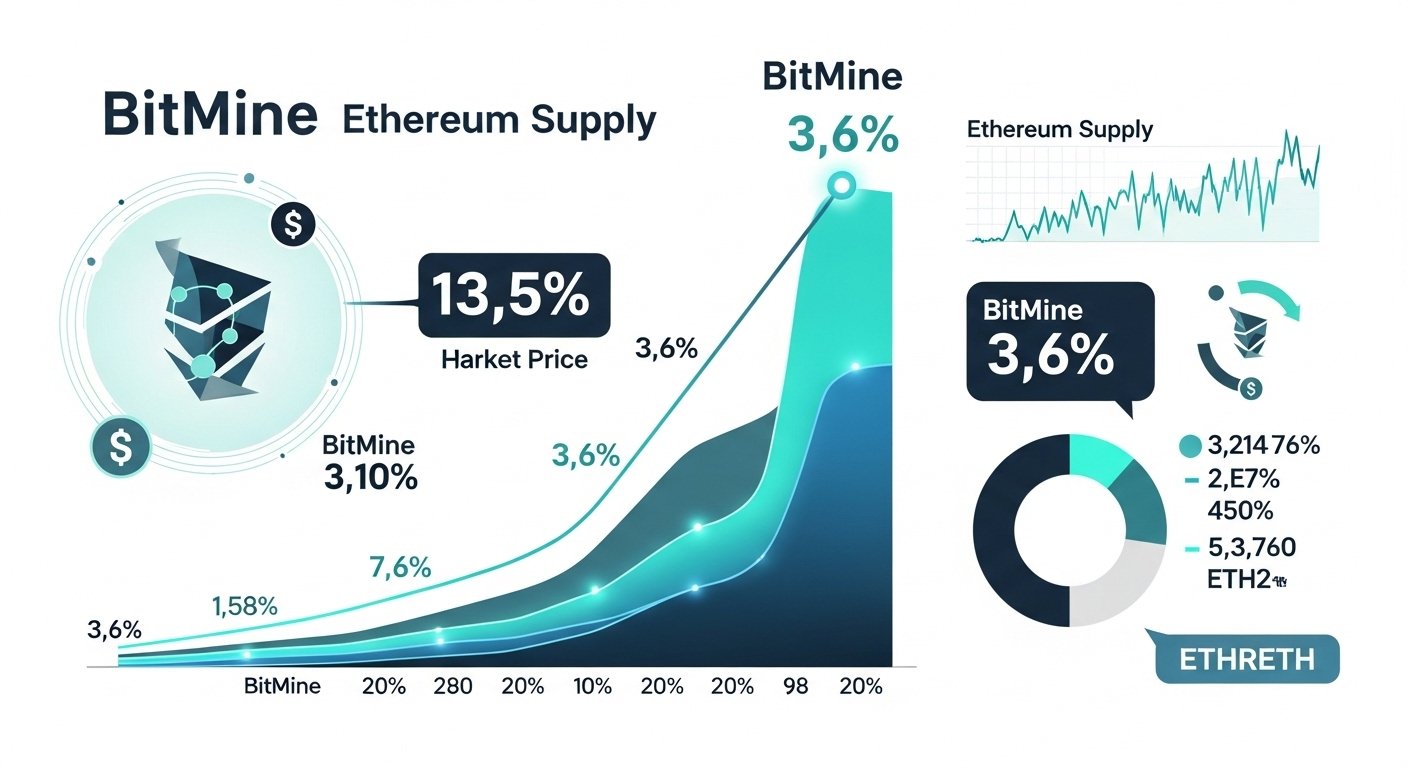
At first glance, 3.6% may appear modest. However, within the context of Ethereum’s total circulating supply, it represents billions of dollars in value. Large-scale holdings can influence market psychology, especially if investors perceive reduced circulating supply or anticipate potential strategic moves from the holder.
In traditional markets, institutional concentration often stabilizes assets by reducing short-term speculation. In crypto markets, however, the effects can be mixed. On one hand, strong institutional backing may boost confidence. On the other hand, traders remain wary of potential sell-offs or shifts in accumulation strategy.
When BitMine ramps Ethereum to 3.6% supply while price tests support, the timing becomes especially important. The alignment of accumulation and technical consolidation suggests that institutions may see current price levels as favorable entry zones.
Ethereum Price Tests Critical Support Levels
While BitMine strengthens its Ethereum position, ETH price action is hovering near key support zones. Support levels represent areas where buying demand historically outweighs selling pressure. When price approaches these zones, traders assess whether the market will rebound or break lower.
The fact that Ethereum is testing support while institutional accumulation increases adds complexity to market interpretation. Some analysts argue that this convergence may indicate underlying strength. Others caution that broader macroeconomic conditions and cryptocurrency market trends could override localized buying pressure.
Technical Analysis and Market Sentiment
From a technical perspective, Ethereum’s price chart reveals a pattern of consolidation after a period of volatility. Consolidation phases often precede significant moves, either upward or downward. Market participants are watching indicators such as trading volume, moving averages, and relative strength index readings to gauge momentum.
Investor sentiment also plays a crucial role. If traders view BitMine’s accumulation as a bullish signal, it could encourage additional buying. Conversely, uncertainty around concentrated ownership might create hesitation. In crypto markets, perception often drives short-term price swings as much as fundamentals.
The broader blockchain adoption narrative remains supportive of Ethereum in the long term. However, short-term price movements are frequently influenced by liquidity, derivatives activity, and macroeconomic developments.
Institutional Influence on Ethereum’s Ecosystem
When BitMine ramps Ethereum to 3.6% supply while price tests support, it underscores the growing role of institutional capital in shaping the crypto ecosystem. Institutional participation brings increased legitimacy, regulatory engagement, and long-term capital inflows. However, it also introduces concerns about centralization within a network designed to be decentralized.
Ethereum’s transition to proof-of-stake has amplified the importance of staking dynamics. Large holders can stake significant amounts of ETH, earning rewards while contributing to network security. BitMine’s holdings may therefore extend beyond passive investment into active participation in consensus mechanisms.
The Balance Between Decentralization and Concentration
One of Ethereum’s core principles is decentralization. When supply becomes concentrated among large entities, critics question whether governance influence or network power could shift disproportionately. While 3.6% does not equate to majority control, it is substantial enough to attract attention.
That said, Ethereum’s distributed validator network mitigates some centralization risks. Even large holders must adhere to protocol rules, and governance changes require broader community consensus. Nevertheless, institutional concentration remains a topic of debate within the community.
The growing presence of corporate players signals maturation of the digital asset space. As crypto asset management evolves, more structured accumulation strategies may emerge, further shaping supply distribution patterns.
Market Liquidity and Supply Dynamics
Supply dynamics are central to understanding price behavior. When a significant percentage of Ethereum’s supply is held by long-term investors, available liquidity decreases. Reduced circulating supply can amplify price movements, particularly during periods of heightened demand.
BitMine’s 3.6% share effectively removes a portion of ETH from active trading markets if the holdings are not frequently moved. This scenario can create scarcity effects, especially if broader adoption trends continue.
Long-Term Holding Versus Active Trading
Institutional accumulation often implies a longer investment horizon. If BitMine intends to hold Ethereum for extended periods, the market impact differs from that of speculative trading. Long-term holding supports price stability by limiting sudden supply influxes.
However, the market must also consider the possibility of strategic reallocations. Even rumors of large transfers can influence sentiment. Transparency in blockchain data allows observers to monitor significant wallet movements, which can both reassure and alarm investors.
As Ethereum price tests support, the interplay between reduced liquidity and potential buying demand becomes crucial. A supply squeeze combined with renewed interest could drive upward momentum.
Broader Crypto Market Context
The timing of BitMine’s accumulation cannot be viewed in isolation. The broader cryptocurrency market is navigating fluctuating macroeconomic conditions, regulatory developments, and shifts in investor risk appetite. Ethereum often moves in correlation with Bitcoin, but it also responds to network-specific catalysts.
The rise of decentralized finance protocols, NFT ecosystems, and tokenized assets continues to strengthen Ethereum’s long-term value proposition. Meanwhile, global economic factors such as interest rate expectations and inflation trends influence capital allocation decisions across risk assets.
Correlation With Bitcoin and Altcoin Trends
Ethereum’s price behavior frequently mirrors broader crypto cycles. When Bitcoin rallies, ETH typically follows, often outperforming during altcoin-driven phases. However, during corrections, Ethereum may experience sharper pullbacks due to higher volatility.
As BitMine ramps Ethereum to 3.6% supply while price tests support, traders analyze whether this marks the early stage of a recovery or part of a deeper consolidation. Cross-market correlations provide clues, but no single indicator guarantees outcomes.
Psychological Impact on Investors
Investor psychology plays an outsized role in cryptocurrency markets. Headlines emphasizing that BitMine ramps Ethereum to 3.6% supply while price tests support can shape narratives quickly. Market participants often react to perceived institutional confidence.
Positive interpretation may lead to increased accumulation by retail investors who view institutional buying as validation. Negative interpretation might focus on fears of centralization or potential market manipulation.
Fear, Confidence, and Strategic Positioning
Periods when price tests support are emotionally charged. Traders face the dilemma of buying potential dips or waiting for confirmation. Institutional accumulation during these phases can instill confidence, signaling belief in long-term value.
At the same time, market participants must distinguish between strategic accumulation and speculative positioning. Understanding the intent behind large holdings is not always straightforward, which contributes to volatility. The intersection of psychology and supply concentration creates a dynamic environment where narratives evolve rapidly.
Long-Term Outlook for Ethereum

Despite short-term uncertainty, Ethereum’s long-term fundamentals remain compelling. Its ecosystem supports thousands of decentralized applications, billions in total value locked within DeFi protocols, and continuous developer innovation.
When BitMine ramps Ethereum to 3.6% supply while price tests support, it may reflect long-term optimism about the blockchain’s role in the future digital economy. Institutional investors often base decisions on multi-year horizons, considering technological roadmaps and adoption curves.
Technological Upgrades and Network Growth
Ongoing network upgrades aimed at improving scalability and reducing transaction costs strengthen Ethereum’s competitive position. Expansion of layer-2 networks enhances throughput and lowers fees, supporting mainstream adoption.
The combination of technical improvements and institutional participation could reinforce Ethereum’s resilience. However, competition from alternative blockchains remains a factor. Continuous innovation is essential for maintaining market leadership.
Risk Factors to Consider
While institutional accumulation appears supportive, risks persist. Market downturns, regulatory interventions, or shifts in macroeconomic conditions could impact Ethereum’s price trajectory. Concentrated holdings may also amplify volatility if significant movements occur.
Investors should consider diversification, risk management strategies, and careful analysis of market conditions. The crypto market remains inherently volatile, and support levels can break under sustained selling pressure.
Regulatory and Macroeconomic Uncertainty
Global regulatory frameworks continue to evolve. Clearer guidelines may boost institutional confidence, but restrictive measures could create short-term disruptions. Additionally, broader financial market instability can spill over into digital assets.
As Ethereum price tests support, external factors may influence outcomes as much as internal dynamics. Understanding the broader economic landscape is crucial for informed decision-making.
Conclusion
The narrative that BitMine ramps Ethereum to 3.6% supply while price tests support encapsulates a pivotal moment for the cryptocurrency market. Institutional accumulation at a time of technical consolidation highlights the evolving maturity of digital assets. While concentration raises questions about decentralization and liquidity, it also signals strong confidence in Ethereum’s long-term prospects.
Ethereum stands at the intersection of innovation, adoption, and market dynamics. As support levels are tested, traders and investors alike must weigh technical signals against fundamental strength. The coming weeks may determine whether this phase becomes a foundation for renewed growth or a precursor to further consolidation. Regardless of short-term fluctuations, Ethereum’s role in the broader blockchain ecosystem remains significant, and institutional participation continues to shape its future trajectory.
FAQs
Q: Why is BitMine increasing its Ethereum holdings significant for the market?
BitMine increasing its Ethereum holdings to 3.6% of the total supply is significant because it represents substantial institutional confidence in Ethereum’s long-term value. Large-scale accumulation can reduce available circulating supply, influence liquidity conditions, and shape investor sentiment. When such accumulation occurs while Ethereum price tests support, it may indicate that institutions view current levels as attractive entry points, potentially stabilizing the market or setting the stage for future growth.
Q: What does it mean when Ethereum price tests support levels?
When Ethereum price tests support levels, it means that the asset is trading near a historically strong price zone where buying demand has previously prevented further declines. Support levels are closely watched by traders because they often determine whether price will rebound or break down. If buying pressure increases at support, a recovery may follow. If support fails, further downside movement can occur.
Q: Could concentrated Ethereum holdings impact decentralization?
Concentrated Ethereum holdings can raise concerns about decentralization, especially if large entities accumulate significant portions of supply. However, Ethereum’s proof-of-stake design distributes validation across thousands of participants, reducing the risk of unilateral control. While 3.6% is substantial, it does not grant governance dominance, though it remains a topic of ongoing debate within the community.
Q: How does institutional accumulation affect Ethereum’s long-term outlook?
Institutional accumulation often reflects a long-term investment perspective. When institutions increase holdings, it suggests confidence in Ethereum’s technology, ecosystem growth, and adoption potential. Over time, sustained institutional participation can enhance market stability, increase credibility, and attract additional capital, supporting a stronger long-term outlook.
Q: Should retail investors react immediately to large institutional moves?
Retail investors should approach institutional moves with careful analysis rather than immediate reaction. While large accumulations may signal confidence, they do not guarantee short-term price increases. Evaluating broader market trends, technical indicators, and personal risk tolerance is essential before making investment decisions. Thoughtful strategy and risk management remain critical in the volatile cryptocurrency market.
