

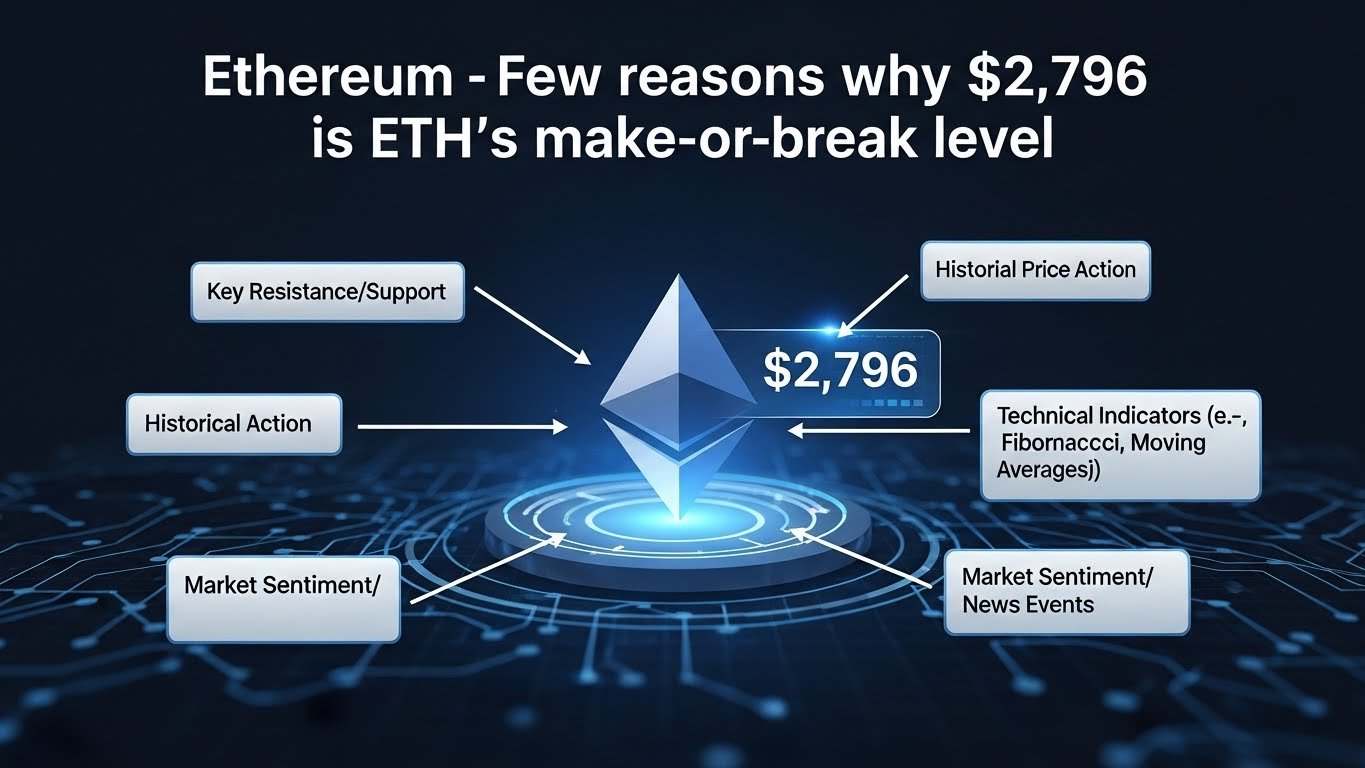
Ethereum has long been regarded as the backbone of the decentralized economy, powering smart contracts, decentralized finance, NFTs, and a rapidly growing ecosystem of blockchain applications. As the second-largest cryptocurrency by market capitalization, Ethereum often sets the tone for the broader altcoin market. Recently, attention has sharply focused on one specific price point: $2,796. Market participants increasingly describe this level as a decisive threshold that could shape Ethereum’s next major move, either reinforcing bullish momentum or triggering deeper corrective pressure.
The importance of this level goes beyond short-term price action. Ethereum’s fundamentals remain robust, yet technical structure, investor sentiment, and macroeconomic conditions have converged around this zone. For traders, long-term holders, and observers of the crypto market, understanding why $2,796 has become such a critical point is essential. This article explores the technical, psychological, and fundamental reasons why this level represents Ethereum’s make-or-break moment, while also examining what could happen if ETH decisively holds above it or falls below it.
Understanding Ethereum’s Current Market Position
Ethereum’s Role in the Crypto Ecosystem
Ethereum is not just another digital asset; it is a programmable blockchain that underpins much of the decentralized world. From decentralized exchanges to lending platforms and digital collectibles, Ethereum’s network activity remains among the highest in the industry. This real-world utility gives ETH a fundamentally different valuation profile compared to purely speculative assets.
Despite this strength, Ethereum’s price is still subject to market cycles. Broader crypto sentiment, Bitcoin’s movements, and global liquidity conditions all influence ETH’s valuation. The $2,796 level has emerged as a point where these forces intersect, making it particularly significant for Ethereum’s near- to medium-term outlook.
Recent Price Action and Market Sentiment
Ethereum’s recent price behavior shows a period of consolidation after previous volatility. During this phase, buyers and sellers have repeatedly tested the $2,796 zone. Each approach to this level has sparked noticeable reactions, signaling that market participants are watching it closely.
This repeated interaction has turned $2,796 into a psychological and technical battleground. Confidence above this level tends to attract renewed buying interest, while weakness below it invites caution and profit-taking.
Why $2,796 Is Technically Significant for Ethereum
A Key Support and Resistance Flip Zone
From a technical analysis perspective, $2,796 represents a classic support and resistance flip zone. Historically, this area has acted as resistance during upward moves and later as support during pullbacks. Such zones often become decisive because they reflect where large volumes of trading activity previously occurred.
When Ethereum trades above this level, it suggests that buyers are willing to defend higher prices. Conversely, sustained trading below $2,796 indicates that sellers have regained control, potentially opening the door to further downside.
Moving Averages and Trend Confirmation
Several widely followed moving averages converge near the $2,796 region. These include medium-term trend indicators that traders use to assess whether Ethereum is in a bullish or bearish phase. When ETH holds above these averages, it reinforces a positive trend structure. When it falls below them, the market often reassesses risk.
Because many trading strategies rely on these indicators, their alignment around $2,796 amplifies the importance of this level. A decisive break in either direction can trigger algorithmic trades and amplify momentum.
Psychological Importance of the $2,796 Level
Investor Behavior and Market Psychology
Psychological price levels often exert outsized influence on market behavior, and $2,796 has become one such point for Ethereum. Investors tend to anchor expectations around familiar prices, especially when those prices have previously marked turning points.
When Ethereum trades near this level, hesitation increases. Buyers want confirmation before committing more capital, while sellers watch closely for signs of weakness. This collective pause heightens volatility and makes the eventual breakout or breakdown more impactful.
Confidence Versus Fear in the ETH Market
Confidence in Ethereum’s long-term prospects remains strong, but short-term fear can still dominate price action. Holding above $2,796 reinforces confidence that the broader uptrend remains intact. Falling below it can quickly shift sentiment, causing fear-driven selling even among fundamentally bullish participants. This tug-of-war between confidence and fear is why $2,796 has become such a critical reference point.
Fundamental Factors Supporting Ethereum
Network Activity and On-Chain Strength
Ethereum’s on-chain metrics continue to show resilience. Transaction volume, active addresses, and developer activity remain high compared to most other blockchains. These fundamentals suggest that Ethereum’s underlying value proposition is intact, regardless of short-term price fluctuations. Such strength provides a foundation that can help ETH defend key levels like $2,796. When fundamentals align with technical support, the probability of a sustained rebound increases.
Upgrades and Long-Term Vision
Ethereum’s ongoing development roadmap plays a crucial role in investor confidence. Network upgrades aimed at improving scalability, security, and efficiency reinforce the perception that Ethereum is evolving to meet future demand. This long-term vision encourages many holders to view dips toward critical levels as potential accumulation opportunities rather than reasons to exit entirely.
Macro Factors Influencing Ethereum at This Level

Broader Crypto Market Conditions
Ethereum does not move in isolation. The overall crypto market environment heavily influences its price behavior. Periods of risk-on sentiment tend to lift ETH above resistance zones, while risk-off phases increase the likelihood of breakdowns.
At $2,796, Ethereum sits at a crossroads where broader market direction could tip the balance. A supportive environment could turn this level into a springboard, while negative sentiment could turn it into a trapdoor.
Global Economic and Liquidity Trends
Macroeconomic factors such as interest rates, inflation expectations, and global liquidity also affect Ethereum. Tighter financial conditions often pressure risk assets, including cryptocurrencies. Looser conditions, on the other hand, tend to benefit assets like ETH that thrive on speculative and innovation-driven capital. These external forces add another layer of complexity to Ethereum’s battle at $2,796.
What Happens If Ethereum Holds Above $2,796
Reinforcing the Bullish Structure
If Ethereum successfully holds above $2,796, it would reinforce the idea that buyers remain in control. This scenario could attract additional capital from traders who have been waiting for confirmation before entering positions. A sustained hold above this level could pave the way for higher price targets, as confidence spreads across the market.
Renewed Interest From Long-Term Investors
Long-term investors often look for confirmation that key support levels are respected before increasing exposure. Holding above $2,796 could encourage these participants to re-engage, adding stability to Ethereum’s price action. This renewed interest could also spill over into related sectors such as decentralized finance and Layer 2 solutions built on Ethereum.
What Happens If Ethereum Breaks Below $2,796
Risk of Accelerated Selling Pressure
A decisive break below $2,796 could trigger accelerated selling. Traders who rely on technical signals may interpret such a move as a breakdown of the current structure, prompting them to exit positions. This selling pressure can become self-reinforcing, especially if stop-loss orders are triggered around this level.
Reassessment of Short-Term Outlook
Falling below this make-or-break level does not negate Ethereum’s long-term potential, but it does force a reassessment of the short-term outlook. Market participants may shift focus to lower support zones while waiting for new signs of strength. Such periods of reassessment are common in crypto markets and often precede the formation of new bases.
Comparing Ethereum’s Current Test to Past Cycles
Lessons From Previous Market Phases
Ethereum has faced similar make-or-break moments in past market cycles. Historically, levels that combined technical significance, psychological importance, and strong fundamentals often determined the next major trend. By comparing current conditions to previous cycles, it becomes clear that $2,796 fits the profile of a level that can define the market’s next phase.
Evolution of Market Maturity
Unlike earlier cycles, today’s Ethereum market includes more institutional participation and sophisticated trading strategies. This maturity can reduce extreme volatility but also make key levels more influential. As a result, the outcome at $2,796 may have more lasting implications than similar tests in the past.
The Role of Volume and Momentum Around $2,796
Volume as a Confirmation Tool
Trading volume provides critical clues about the strength of moves around $2,796. Rising volume during a bounce suggests genuine demand, while low volume may indicate a lack of conviction. Monitoring volume helps distinguish between temporary fluctuations and meaningful trend shifts.
Momentum Indicators and Market Direction
Momentum indicators often align with major price levels. Around $2,796, these indicators can quickly shift from neutral to bullish or bearish, amplifying market reactions. This sensitivity underscores why traders view this level as a pivot for Ethereum’s momentum.
Broader Implications for the Altcoin Market

Ethereum as a Market Leader
Ethereum’s performance often influences the broader altcoin market. A strong hold above $2,796 could boost confidence across altcoins, while a breakdown could dampen enthusiasm. Because many projects are built on Ethereum, its price stability has ripple effects throughout the ecosystem.
Signal for Risk Appetite
The outcome at this level also serves as a signal for overall risk appetite in the crypto market. Strength suggests a willingness to take risk, while weakness signals caution. This makes Ethereum’s test at $2,796 relevant even for those not directly invested in ETH.
Conclusion
Ethereum’s battle at $2,796 represents far more than a single price point. It encapsulates the intersection of technical structure, market psychology, fundamental strength, and macroeconomic forces. As a support and resistance zone, a psychological benchmark, and a convergence of key indicators, this level has earned its reputation as ETH’s make-or-break threshold.
Holding above $2,796 could reinforce bullish momentum, attract renewed investment, and strengthen confidence in Ethereum’s near-term outlook. Falling below it could invite caution, trigger selling pressure, and lead to a period of consolidation or correction. Regardless of the immediate outcome, Ethereum’s long-term fundamentals remain compelling, suggesting that this moment is part of a broader evolutionary journey rather than a final verdict. For market participants, understanding why $2,796 matters provides valuable context for navigating Ethereum’s next move with clarity and perspective.
FAQs
Q: Why is $2,796 considered a make-or-break level for Ethereum
The $2,796 level combines technical significance, psychological importance, and alignment with key indicators, making it a critical zone where market direction is likely to be decided.
Q: Does falling below $2,796 mean Ethereum’s long-term outlook is bearish
A break below this level affects short-term sentiment but does not invalidate Ethereum’s long-term fundamentals, which remain supported by strong network activity and development.
Q: How do fundamentals influence Ethereum’s ability to hold this level
Strong fundamentals such as high network usage, developer activity, and ongoing upgrades provide underlying support that can help Ethereum defend key price levels like $2,796.
Q: Can broader market conditions override the importance of this level
Yes, broader crypto sentiment and global economic conditions can influence Ethereum’s price behavior, potentially reinforcing or weakening the impact of the $2,796 level.
Q: What should investors watch alongside the $2,796 price level
Investors should monitor volume, momentum indicators, and overall market sentiment to better understand whether moves around $2,796 are likely to be sustained or temporary.
