


Ethereum network usage has reached a record high, signaling a powerful resurgence in on-chain activity, decentralized applications, and smart contract adoption. Daily transactions, active addresses, and gas utilization all point toward an ecosystem that is more active and more essential than ever before. Yet, despite this undeniable strength in blockchain fundamentals, traders are showing stronger bullish sentiment toward gold rather than Ethereum or the broader crypto market. This contrast reveals a deeper story about global risk perception, capital preservation, and how investors are positioning themselves in an uncertain economic environment.
The headline Ethereum network usage hits record high—but traders more bullish on gold captures a market paradox. On one side, Ethereum is proving its technological relevance and real-world utility. On the other, capital flows and trader positioning suggest that traditional safe-haven assets still dominate during periods of macroeconomic tension. This divergence between usage metrics and investment sentiment is shaping the next phase of both crypto and commodity markets.
Ethereum network activity is surging, what is driving renewed enthusiasm for gold, and how these seemingly opposing trends coexist. By analyzing blockchain data, trader behavior, macroeconomic forces, and long-term investment narratives, we uncover what this moment means for Ethereum, gold, and the future of global markets.
Ethereum Network Usage Reaches Unprecedented Levels
Ethereum’s record-breaking usage reflects years of steady development, scaling improvements, and expanding use cases. The network now supports a vast ecosystem of decentralized finance protocols, NFT platforms, gaming applications, enterprise solutions, and tokenized real-world assets. Each interaction contributes to higher transaction counts and sustained demand for block space.
One of the main drivers behind this surge is the continued growth of decentralized applications built on Ethereum. Developers increasingly favor Ethereum due to its security, composability, and mature tooling. As more applications go live and attract users, network usage naturally increases. This organic demand is a strong indicator of long-term value creation rather than speculative activity.
Layer two solutions have also played a crucial role. By reducing transaction costs and improving throughput, these scaling technologies make Ethereum accessible to a broader audience. As usability improves, participation grows, reinforcing Ethereum’s position as the backbone of decentralized innovation.
Smart Contracts and DeFi Fueling On-Chain Growth
Smart contracts remain the core engine behind Ethereum’s rising network usage. These self-executing programs automate financial agreements, governance processes, and digital ownership without intermediaries. Their versatility continues to unlock new applications across industries.
Decentralized finance has been a major contributor to record usage levels. Lending platforms, decentralized exchanges, derivatives protocols, and yield strategies all rely heavily on Ethereum’s infrastructure. Even during periods of muted price action, DeFi activity remains resilient because users engage for functionality rather than speculation.
As institutional experimentation with tokenization and on-chain settlement expands, smart contract interactions are becoming more complex and frequent. This trend supports sustained network demand regardless of short-term market sentiment.
Network Fundamentals Versus Market Sentiment
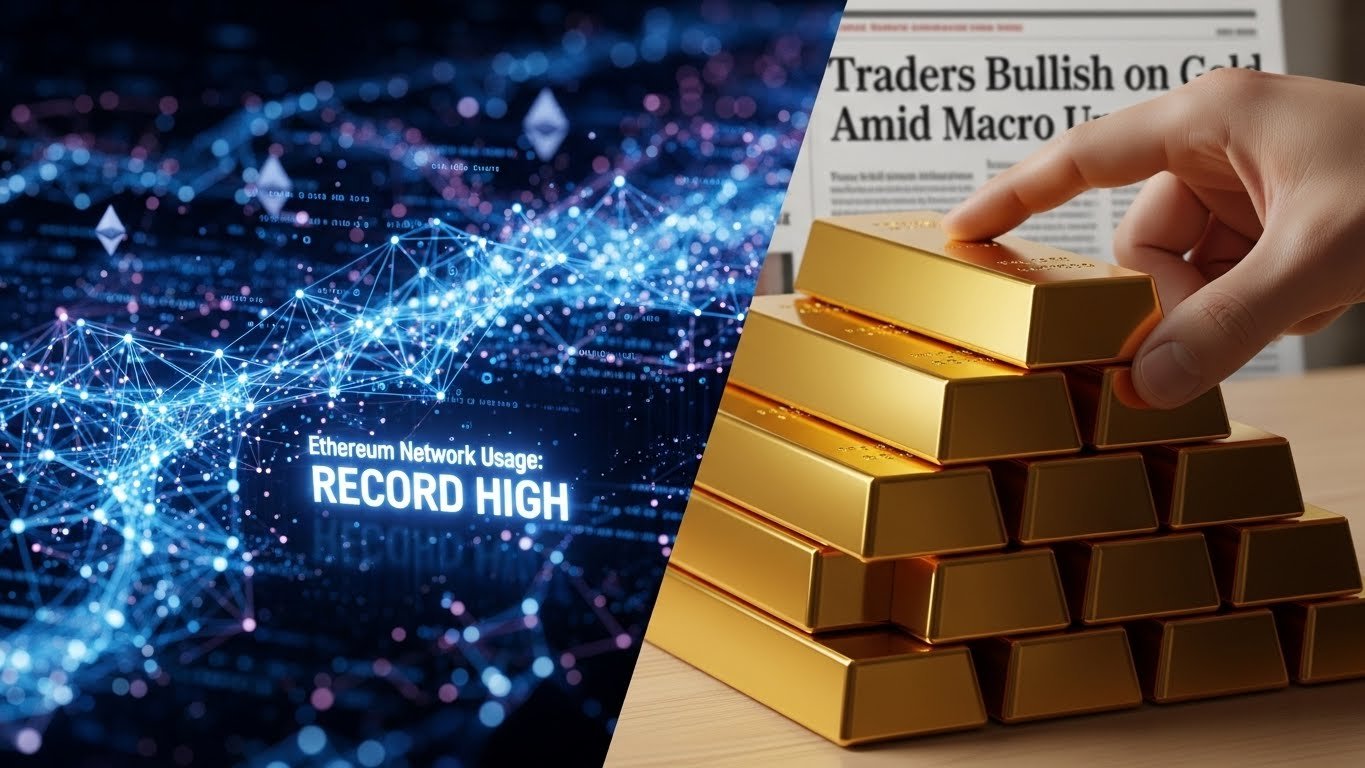
Despite Ethereum’s strong fundamentals, market sentiment tells a different story. Traders are increasingly cautious, prioritizing assets perceived as stable and time-tested. While Ethereum network usage hits record high, traders more bullish on gold reveals how sentiment can diverge from technological progress.
Crypto markets remain sensitive to macroeconomic signals, regulatory developments, and liquidity conditions. Even with robust on-chain data, price action often reflects broader risk appetite rather than network health alone. Traders may acknowledge Ethereum’s strength while still allocating capital elsewhere for short-term safety. This disconnect highlights an important distinction between users and investors. Ethereum can thrive as a platform even when speculative interest temporarily shifts away.
Gold’s Resurgence as a Safe-Haven Asset
Gold’s renewed bullishness stems from its historical role as a store of value during uncertainty. As inflation concerns persist, geopolitical tensions remain elevated, and monetary policy outlooks fluctuate, traders gravitate toward assets with long-standing reputations for stability.
Gold benefits from deep liquidity, global acceptance, and independence from digital infrastructure. For many institutional investors, it remains a cornerstone of risk management strategies. The fact that traders are more bullish on gold does not necessarily imply a rejection of crypto, but rather a preference for balance during volatile periods. This behavior underscores the enduring appeal of safe-haven assets when confidence in growth-oriented investments weakens.
Macro Forces Shaping Trader Preferences
Macroeconomic dynamics play a central role in shaping asset allocation decisions. Interest rate expectations, currency fluctuations, and economic growth forecasts all influence whether investors seek risk or safety. In the current environment, uncertainty dominates.
Even as Ethereum network usage hits record high, traders more bullish on gold reflects caution toward assets perceived as volatile. Crypto markets, while maturing, are still viewed as higher risk compared to traditional commodities. This perception influences short-term positioning, especially among leveraged traders and large funds. Macroeconomic stress often leads to capital rotation rather than outright exits, with investors adjusting exposure based on prevailing conditions.
Ethereum as Infrastructure Rather Than Speculation
One reason Ethereum continues to grow despite muted trader enthusiasm is its evolution into critical infrastructure. Ethereum is no longer just a speculative asset but a foundational layer for digital finance and decentralized services.
Users interact with Ethereum because they need its capabilities, not because they expect immediate price appreciation. This shift from speculation to utility strengthens the network’s resilience. Blockchain infrastructure adoption tends to follow long-term trends rather than short-term sentiment.
As more real-world use cases depend on Ethereum, network usage can reach record highs even when market prices consolidate.
Investor Time Horizons and Asset Selection
Differences in time horizon also explain why Ethereum and gold attract different types of participants. Long-term builders, developers, and users drive Ethereum’s usage metrics. Short-term traders and risk managers influence capital flows into gold.
Gold appeals to those seeking wealth preservation over decades, while Ethereum attracts innovators and early adopters focused on future growth. These roles are not mutually exclusive, but they respond differently to market signals. Understanding these distinctions helps explain why strong on-chain data does not always translate into immediate bullish price action.
Correlation and Diversification Dynamics
Another important factor is diversification. Many investors hold both crypto assets and gold as part of a balanced portfolio. When risk appetite shifts, allocations change without eliminating exposure entirely.
Ethereum network usage hits record high—traders more bullish on gold suggests that diversification strategies are at work. Investors may reduce crypto exposure temporarily while maintaining long-term positions. This behavior supports network activity even as speculative demand softens. Diversification reflects maturity in investment approaches rather than loss of confidence.
Ethereum’s Long-Term Value Proposition

Ethereum’s long-term value proposition remains compelling. Its dominance in smart contracts, ongoing upgrades, and growing developer community position it as a foundational technology for the digital economy. Network usage metrics provide tangible evidence of this trajectory. As scalability improves and user experience evolves, Ethereum is likely to attract even more activity. Ethereum ecosystem growth is driven by innovation cycles that extend beyond market sentiment. Long-term investors often view periods of cautious sentiment as opportunities rather than threats.
Gold Versus Digital Assets in the Modern Era
The comparison between gold and Ethereum reflects broader debates about value in the modern era. Gold represents tradition, scarcity, and physical assurance. Ethereum represents programmability, innovation, and digital coordination. Both assets address different needs. Gold excels at preserving value during uncertainty, while Ethereum enables new economic models and services. The fact that traders are more bullish on gold does not diminish Ethereum’s achievements but highlights complementary roles. This coexistence suggests that future portfolios may increasingly blend traditional and digital assets.
Market Cycles and Shifting Narratives
Market narratives evolve with cycles. During growth phases, innovation-driven assets like Ethereum attract enthusiasm. During consolidation or uncertainty, defensive assets like gold regain favor.
Ethereum network usage hits record high during a period of cautious sentiment demonstrates that technological progress does not pause for market cycles. Usage growth lays the foundation for future valuation increases when sentiment shifts. Understanding cycles helps investors avoid misinterpreting short-term trends as long-term signals.
Implications for Traders and Long-Term Holders
For traders, the current environment emphasizes risk management and flexibility. Gold’s appeal reflects a desire for stability, while crypto exposure is managed carefully. For long-term holders, Ethereum’s record usage reinforces confidence in its fundamental strength. These perspectives are not contradictory but complementary. Markets accommodate multiple strategies simultaneously, each responding to different objectives and constraints. Recognizing this diversity is essential to interpreting headline trends accurately.
Conclusion
Ethereum network usage hits record high—yet traders more bullish on gold captures a nuanced moment in global markets. Ethereum’s blockchain is thriving, supporting unprecedented levels of activity driven by real utility, innovation, and infrastructure adoption. At the same time, traders are gravitating toward gold as macroeconomic uncertainty shapes short-term sentiment and risk preferences.
This divergence highlights the difference between technological fundamentals and investment psychology. Ethereum continues to build long-term value through usage and development, while gold fulfills its role as a safe-haven asset. Together, these trends illustrate a maturing financial landscape where digital and traditional assets coexist rather than compete. As market conditions evolve, sentiment may shift again. When it does, Ethereum’s record-breaking usage could serve as a powerful foundation for renewed investor confidence and future growth.
FAQs
Q: Why is Ethereum network usage increasing even when traders are cautious?
Ethereum network usage is increasing because it is driven by real-world applications such as decentralized finance, smart contracts, and digital services. These use cases depend on functionality rather than price speculation, allowing activity to grow regardless of short-term trader sentiment.
Q: What makes traders more bullish on gold than Ethereum right now?
Traders are more bullish on gold due to macroeconomic uncertainty, inflation concerns, and its long-standing reputation as a safe-haven asset. Gold is often favored during periods of risk aversion, while crypto assets are viewed as higher risk in the short term.
Q: Does strong Ethereum network usage guarantee higher prices?
Strong network usage is a positive fundamental indicator, but it does not guarantee immediate price increases. Market prices are influenced by sentiment, liquidity, and macro factors, which can temporarily overshadow on-chain strength.
Q: Can Ethereum and gold both be part of a balanced investment strategy?
Yes, Ethereum and gold can complement each other in a diversified portfolio. Gold provides stability and risk protection, while Ethereum offers exposure to innovation, growth, and the expanding digital economy.
Q: What should long-term investors focus on amid this divergence?
Long-term investors should focus on fundamentals such as Ethereum’s ecosystem growth, technological development, and adoption trends. Short-term sentiment shifts toward gold do not negate the long-term value proposition of Ethereum’s network.
