


The debate surrounding Ethereum price prediction has intensified as the world’s second-largest cryptocurrency struggles to regain strong bullish momentum. With Ethereum trading below the crucial $2,000 psychological level, investors are questioning whether the asset can stage a recovery or remain suppressed for an extended period. The concern grows deeper as on-chain data indicates that major holders, often referred to as whales, have been steadily reducing their holdings over the past 90 days.
Ethereum, powered by its native token ETH, plays a central role in the decentralized finance ecosystem and supports thousands of decentralized applications. However, market sentiment, macroeconomic pressure, and whale distribution patterns are now shaping the short-term outlook. In this in-depth Ethereum price prediction analysis, we explore whether ETH could remain below $2K, the impact of whales cutting holdings, and the broader technical and fundamental forces influencing price action.
Understanding Ethereum’s Current Market Position
Ethereum remains one of the most influential blockchain networks in the crypto space. Since transitioning to proof-of-stake in 2022, the network has aimed to improve scalability and reduce energy consumption. Despite these structural improvements, price performance has been heavily influenced by market cycles.
The current Ethereum price prediction narrative centers around declining momentum. ETH has faced resistance near $2,000 multiple times, failing to establish a decisive breakout. This repeated rejection has strengthened the perception of $2K as a psychological barrier.
From a market structure standpoint, Ethereum is currently trading within a consolidation range. While long-term believers emphasize the network’s utility, short-term traders focus on liquidity levels, resistance zones, and whale activity.
Whale Activity and Its Impact on Ethereum Price Prediction
What Does Whale Selling Mean for ETH?
Whales are large holders who control significant amounts of ETH. When these investors accumulate, it often signals confidence. When they distribute or reduce holdings, it can signal caution or preparation for downside.
Recent blockchain data suggests that whales have been cutting their holdings for nearly 90 consecutive days. This trend directly affects Ethereum price prediction models because large sell-offs increase circulating supply in the market.
The reduction in whale holdings creates additional sell pressure. Even if retail demand remains stable, large transactions from whales can shift market dynamics quickly.
Why Are Whales Reducing Holdings?
There are several possible reasons for this distribution phase. Some whales may be securing profits after previous rallies. Others might be reallocating capital into alternative digital assets or stablecoins amid macroeconomic uncertainty. The broader crypto market volatility has also played a role, especially as global interest rate policies continue to influence risk assets.
From a strategic standpoint, whales often act ahead of retail investors. Their 90-day selling trend has amplified bearish Ethereum price prediction discussions, particularly regarding the $2K level.
Technical Analysis: Can ETH Break Above $2K?
Technical indicators provide important insights into short-term Ethereum price prediction scenarios. ETH has been forming lower highs on higher time frames, suggesting weakening bullish momentum.
The $2,000 level is not just psychological; it also represents a strong technical resistance zone. Repeated rejections from this area indicate that sellers remain dominant.
Key Support Levels to Watch
Ethereum’s immediate support lies near $1,750, followed by stronger structural support around $1,600. If these levels fail, the next significant zone appears closer to $1,400.
The Ethereum price prediction outlook becomes increasingly bearish if price closes below major support levels with strong volume confirmation.
Momentum Indicators and Trend Signals
Indicators such as RSI and MACD show mixed signals. At times, Ethereum appears oversold, suggesting potential short-term rebounds. However, without sustained buying pressure, these bounces may remain temporary.
The broader technical analysis patterns indicate consolidation rather than clear bullish reversal. This reinforces the possibility that ETH could remain below $2K unless a major catalyst emerges.
Macro Factors Influencing Ethereum Price Prediction

Cryptocurrencies do not operate in isolation. Macroeconomic conditions heavily influence Ethereum price prediction outcomes.
Interest rate hikes, inflation data, and global liquidity trends directly affect investor appetite for risk assets. When monetary policy tightens, speculative assets like ETH often face downward pressure.
Additionally, regulatory uncertainty in major economies contributes to cautious investor behavior. Regulatory developments can either spark rallies or trigger sharp corrections depending on market interpretation.
The interplay between macro conditions and whale selling strengthens the argument that Ethereum may struggle to break above $2K in the short term.
On-Chain Metrics and Network Fundamentals
Despite bearish price action, Ethereum’s network fundamentals remain strong. Active addresses, staking participation, and total value locked in decentralized finance protocols continue to demonstrate long-term demand.
The Ethereum price prediction conversation must balance short-term price weakness with long-term adoption growth. Ethereum remains the backbone of the decentralized finance ecosystem, hosting thousands of smart contracts and decentralized applications.
The network’s deflationary mechanics, introduced through EIP-1559, reduce ETH supply over time during periods of high transaction activity. This structural feature could support price stability in the long run.
However, strong fundamentals do not always translate into immediate price appreciation. Market sentiment and liquidity conditions often dominate short-term price movements.
Market Sentiment and Retail Behavior
Sentiment plays a critical role in Ethereum price prediction models. Fear-driven markets can exaggerate downside moves, especially when headlines highlight whale selling.
Retail investors often react emotionally to large holder movements. When whales reduce holdings, panic selling can amplify volatility.
Social sentiment indicators suggest cautious optimism rather than extreme fear. Many traders are waiting for confirmation of a breakout above $2K before entering large positions.
The broader digital asset market trends indicate consolidation across major cryptocurrencies, not just Ethereum. This suggests that ETH’s stagnation below $2K is part of a wider market cycle rather than an isolated event.
Bullish Scenario: What Could Push ETH Above $2K?
While current data suggests caution, a bullish Ethereum price prediction scenario remains possible.
A sustained increase in trading volume combined with positive macro developments could trigger a breakout. Additionally, renewed institutional interest in spot Ethereum products may provide upward momentum.
If whale selling slows or reverses into accumulation, market confidence could improve significantly. Historically, whale accumulation phases have preceded strong rallies.
Ethereum’s ongoing scalability upgrades and layer-two adoption also strengthen its long-term value proposition. The growth of blockchain adoption across industries could drive renewed investor interest.
A decisive weekly close above $2,000 would likely shift Ethereum price prediction sentiment toward bullish territory.
Bearish Scenario: Could ETH Stay Below $2K?
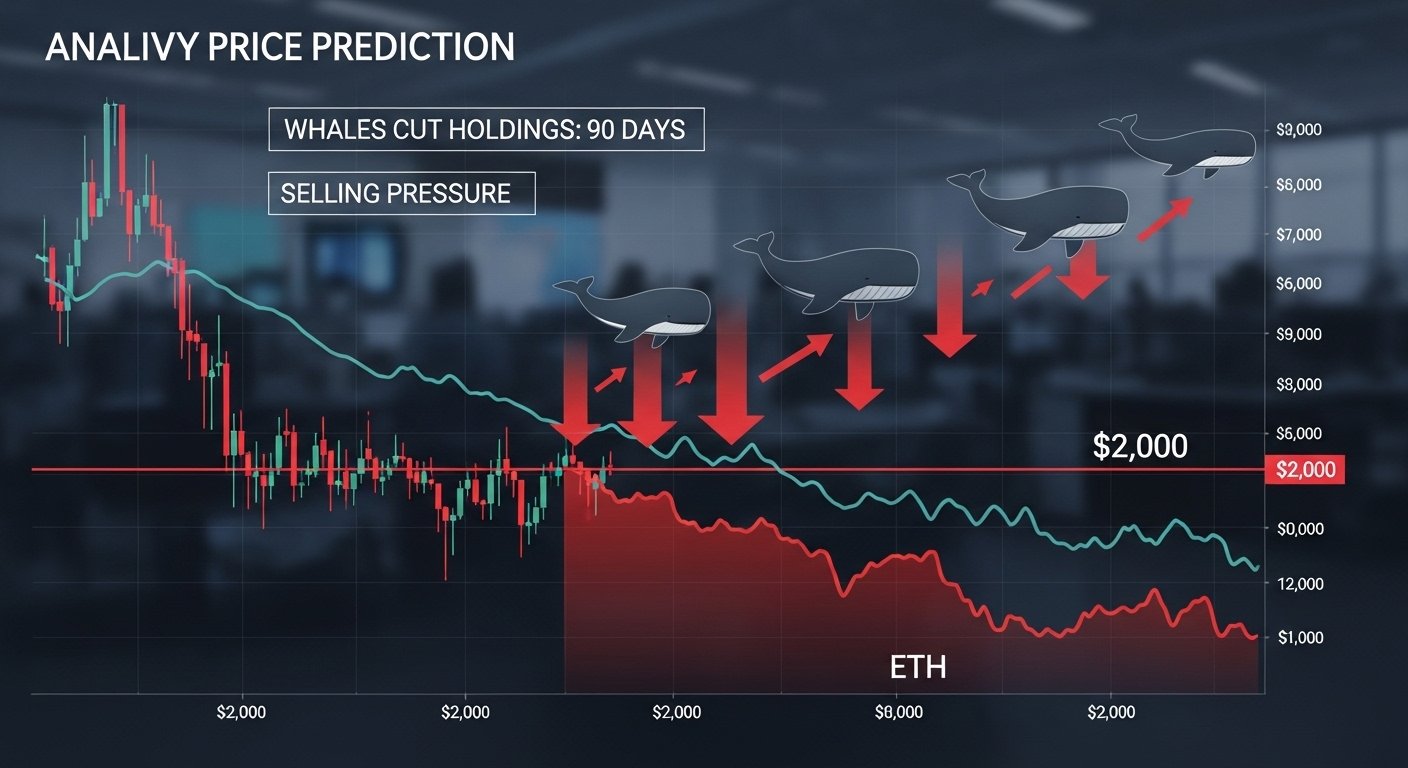
The bearish Ethereum price prediction outlook focuses on continued whale distribution and weak macro conditions.
If ETH fails to break above resistance and instead breaks below key support levels, prolonged consolidation below $2K becomes likely.
Continued risk-off sentiment in global markets may suppress demand for cryptocurrencies. Additionally, unexpected regulatory announcements could increase volatility.
In this scenario, Ethereum could trade between $1,400 and $1,900 for an extended period. Such a range-bound environment would frustrate both bulls and bears while allowing accumulation at lower levels.
Long-Term Ethereum Price Prediction Outlook
Zooming out beyond short-term volatility, Ethereum’s long-term prospects remain tied to innovation and adoption. The network’s dominance in smart contracts, NFTs, and DeFi gives it structural advantages. Over time, these fundamentals could outweigh temporary whale selling pressure. Long-term Ethereum price prediction models often focus on supply dynamics, staking growth, and network revenue. If adoption continues expanding, ETH may eventually reclaim and surpass $2K. However, patience is crucial. Market cycles in cryptocurrency can last months or even years before decisive trends emerge.
Conclusion
The question of whether Ethereum could remain below $2K as whales cut holdings over 90 days is complex. Whale selling introduces clear downward pressure, and technical resistance at $2,000 remains strong. Macroeconomic conditions further complicate short-term recovery prospects.
Yet Ethereum’s network fundamentals, deflationary mechanics, and ongoing innovation provide long-term optimism. The Ethereum price prediction outlook suggests that while ETH may struggle below $2K in the near term, structural growth could eventually support a breakout. Investors should closely monitor whale activity, macroeconomic developments, and key technical levels. The coming months will likely determine whether Ethereum remains range-bound or begins its next upward cycle.
FAQs
Q: Why are whales cutting Ethereum holdings for 90 days?
Whales may reduce holdings for various strategic reasons, including profit-taking after previous rallies, portfolio diversification, or risk management during uncertain macroeconomic conditions. Their long-term selling trend can influence Ethereum price prediction because large transactions increase supply pressure and affect market sentiment. However, whale distribution does not always indicate a long-term bearish outlook, as these investors may re-enter at lower levels.
Q: Is $2,000 a strong resistance level for Ethereum?
Yes, $2,000 is considered both a psychological and technical resistance level. Ethereum has faced multiple rejections around this price, reinforcing its importance in Ethereum price prediction analysis. A strong breakout above this level with high trading volume could signal renewed bullish momentum and shift market sentiment significantly.
Q: Can Ethereum fall below $1,500 if whale selling continues?
If whale distribution continues and broader market conditions remain weak, Ethereum could test lower support levels near $1,600 or even $1,400. Ethereum price prediction models suggest that sustained selling pressure combined with negative macro factors could push prices lower. However, strong support zones often attract buyers looking for discounted entry points.
Q: How do macroeconomic conditions affect Ethereum price prediction?
Macroeconomic factors such as inflation, interest rates, and global liquidity directly impact investor appetite for risk assets. When central banks tighten monetary policy, cryptocurrencies often experience downward pressure. Ethereum price prediction must therefore account for global economic trends alongside blockchain-specific data.
Q: Is Ethereum still a good long-term investment despite staying below $2K?
Long-term investors often focus on Ethereum’s role in decentralized finance, smart contracts, and blockchain infrastructure rather than short-term price fluctuations. Even if Ethereum remains below $2K temporarily, its strong fundamentals and continued adoption may support future growth. Ethereum price prediction over longer time horizons typically emphasizes innovation and network expansion rather than temporary whale-driven volatility.
